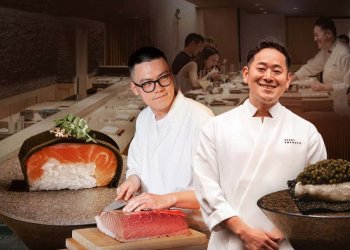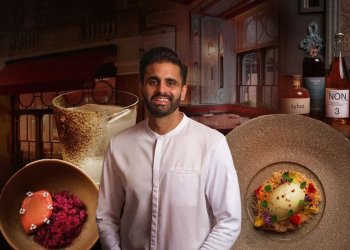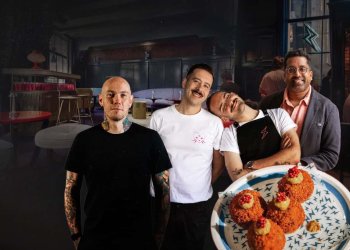




Eight restaurants. Eight architecture firms. One question: how do you translate flavor into form? At Hozo City Tết Fest 2025, Vietnam’s leading culinary voices – from MICHELIN-starred kitchens to funky eateries – have been paired by MÊ VỊ® in their Mê Tales® section with the country’s most inventive architects to build pavilions that capture the essence of their dining experience.
“Strictly considered, writing about music is as illogical as singing about economics,” Martin Mull famously wrote in 1979 for the Detroit Free Press magazine. With that in mind, how can an architectural pavilion capture the essence of a restaurant? MÊ VỊ®, the culinary-cultural component of Hozo City Tết Fest 2025, has paired eight architectural firms with eight restaurants to create a dialogue between construction and cuisine, dining and design.

Ready To Be Brave Again
“Vietnam in 2025 feels like it’s ready to be brave again,” says Vicky Lam, the festival’s culinary program advisor. “Things are more globalized, more connected, and noticeably less cautious right now. People are taking risks, mixing influences, and trying new models. It’s not always polished, but it’s interesting, energetic, and very much alive.”
“There has been a rise in expression in modern contemporary architecture and interior design across the city – residential homes, cafes, restaurants, and even resorts,” adds An Ha, the festival’s culinary strategic director. “It might be the influence of Pinterest before and now Instagram and TikTok, but people are starting to pay attention to this field, which is very exciting.”
Cafes and restaurants are using design as part of their identity, as a point of differentiation and self-expression.

Beyond The Ready-Made
So when Tien Vo – the festival creative director – Vicky, An Ha, and the organizers started mapping out the food program, like any discerning diner, they wanted something that went beyond the ready-made. “The conversation was about possibility: what role food could play if we treated it as culture, not just content,” Vicky elaborates.
“As the idea evolved, another layer was added that made MÊ VỊ®️ even more interesting: bringing together eight founders of eight architecture firms and pairing each of them with a restaurant,” Tien adds.
Each firm worked closely with their restaurant to translate its story, philosophy, and obsessions into space, using architecture as narrative tool. Form, material, and atmosphere became the language for a restaurant’s identity. The result is eight distinct pavilions that feel like chapters in the same book.

At Hozo City Tết Fest 2025’s MÊ VỊ® The Restaurants Serve As Inspiration
The restaurants serving as inspiration include two with MICHELIN stars. Peter Cuong Franklin’s Anan Saigon, pioneer of ‘cuisine mới,’ was the first ever to receive the accolade in Ho Chi Minh City in 2023, and CoCo Dining, Chef Vuong’s culinary ode to childhood, was the latest to win the coveted honor, announced at the very end of the ceremony in Danang this year.
The six other restaurants also featured in the MICHELIN Guide 2025. Summer Le’s Nén Light is a whimsical space serving deeply personal tasting menus. Duy’s Little Bear ushered in a new era of bright, breezy, funky, wine-fueled eateries (picking up MICHELIN’s Young Chef of the Year accolade for his hard work).
Nephele is Francis Thuan’s evolved take on fire-cooking, and its dapper sommelier Paul is MICHELIN’s Sommelier of the Year. At The Monkey Gallery DINING, Hau Tran serves cultured and conceptual tasting menus in a creative downtown space.
Quince Saigon is a perennial favorite, serving flame-licked dishes with touches of French, Middle Eastern, and more recently Thai and Asian cuisine. Finally, the newest of the bunch, ST25 is a tribute to Vietnam’s award-winning ST25 rice and the restaurant – part of KOTO – helps underprivileged hospitality hopefuls get a start in the industry.

Eight Restaurants Paired With Eight Vietnam-Based Architecture Practices
They’ve been paired with eight Vietnam-based practices. Tran Vu Dinh Duy’s Gerira Architects are renowned for their residential projects, even creating living spaces for a restaurateur family with an abundant kitchen to try out recipes. LAITA is an interdisciplinary design firm – the name comes from ‘lai,’ the Vietnamese term for mixing cultures or even DNA, and ‘ta,’ slang for ‘me’ or ‘we.’
nhabe scholae is a French-Vietnamese practice led by Nguyen Anh Cuong that revives forgotten Saigon shophouses and midcentury modernist buildings through light, memory, and minimal intervention.
The process-oriented, inquisitive, and visionary Ho Chi Minh studio Aaaaa, led by architect Le Huu Triet is known for resourceful, temporary structures like the TBD Office – a corrugated metal workspace on stilts that embraces Vietnam’s tropical climate and fast-changing urban fabric.
Then there’s LAM Weaving Spaces, founded by Kieu Lam. They are specialist curtain makers and spatial fabricators who collaborate with architects to create floating installations, from traditional dó paper lanterns at Văn Miếu to custom textile systems in contemporary homes.
Saigon-based practice sgnhA, co-founded by Tran Quoc Khoi Nguyen and Nguyen Duc Tuan Anh, transforms old shophouses into cinematic spaces for cafes and creative offices, blending vernacular Vietnamese architecture with whimsical, layered interiors.
Dinh Tat Dat founded 324PRAXIS in 2019. This Ho Chi Minh firm rethinks Vietnamese tube houses through elevated perspectives, circular columns as picture frames, and hospitality projects that blur boundaries between public and private.
Finally, Tran Manh Hung’s voides is a practice founded in 2015 that designs around the ‘void’ – seeing potential in negative spaces within objects and buildings, focusing on the core user experience rather than the structure itself.

Like A Plate Of Crispy Fried Noodles
“It’s like a plate of crispy fried noodles,” Aaaaaa’s Le Huu Triet laughs about their pavilion. “But with many types of noodles: thin noodles, flat noodles, wide noodles…” They’re genuinely enthused about the “rawness and authenticity” the event offers. “We get a chance to learn not only through co-practice, but also through the open sharing of resources, constraints, and decision-making processes behind the event.”
Cuisine, they argue, has always been a multi-sensory experience. Space, materials, light, and sound combined with food – its textures, ingredients, and flavor profiles – create experiences that are subjective and special.
After spending three years studying abroad, Le Huu Triet feels a little aloof from the current culinary scene. So this has been a chance to rediscover contemporary flavors. “Plus, you can clearly sense the creative energy that has been simmering for a long time here and that’s now truly exploding with great intensity.” The kind of energy emanating from their restaurant partner for this special collaboration, Little Bear.

These Opportunities Don’t Come Around Often
The harmonious team spirit sgnhA’s Tran Quoc Khoi Nguyen and Nguyen Duc Tuan Anh have cultivated at their small office in Tan Dinh is reflected in their consideration for environment in their design for their pavilion with Monkey Gallery DINING.
They’ve enjoyed the challenge of bringing the restaurant’s spirit to life in their pavilion. “These opportunities don’t come around often,” they explain. “The chance to meet contemporaries who are exploring the same project allows us to recognize differences and to learn and reflect on what we do.”
In the open park space where they’ll construct it, “sun, wind, and rain are the natural elements that could all be present.” In these drier months, they’ve focused on shadows cast by their pavilion, which will create “vibrant silhouettes.” There’ll be light spheres floating in the wind on a stretched mesh, kissed by the breeze and held flat by anchor blocks.
They’d liken the design to a stew – maybe braised fish or braised pork with eggs – “with lots of spices, requiring a lot of time, and vaguely evoking a sense of place and time.”

Inspiration In Architecture Never Comes From Nothing
Gerira Architects and Tran Vu Dinh Duy are more blasé about the whole thing. “Creating architecture always comes with a brief,” they contend. MÊ VỊ® have simply offered another in pairing them with Anan Saigon. Each one comes with constraints like budget and timeline. But they can be sources of inspiration too, they explain: “Inspiration in architecture never comes from nothing.”
Their philosophy is: ‘Nhà sạch thì mát, bát sạch ngon cơm,’ meaning something along the lines of ‘a clean house makes your home fresh, a clean bowl makes your rice tasty.’
And, they say, their design for the pavilion they’ve partnered with Anan Saigon is like that – “something balanced and peaceful amidst the noise of the festive atmosphere.”
“We wanted it to be simple, a dish like pickled eggplant that contributes to the ‘meal’ of the event, perhaps adding depth to the range of flavors but remaining uncomplicated.”
Nguyen Anh Cuong and nhabe scholae take an artful approach to projects. “Poetry,” he explains, “is our humble answer to a materialistic and unstable world.” His recollections of his most meaningful culinary experiences are lyrical too. “I mostly remember who I was with. As long as it’s not too sloppy and there’s care involved, that’s fine,” he shrugs.
The temporary nature of the project gave Cuong and nhabe scholae pause. “Working in a consumer-oriented, temporary context isn’t very appealing,” he admits. But the chance to create something for the public was enough for them to say yes.

Nén Light offers a fitting partner. Summer and the team source obscure local ingredients from across the country and serve them in thematic tasting menus full of storytelling. “And earthy materials and organic forms are recurring themes in our designs too,” Cuong continues. Summer’s Nén Light is sensitive to the sensory experience – you can request the waitstaff talk a little or a lot, and she’s paired courses with songs that signify moments in her life. “For us, we’ve also always pursued the themes of the senses and the body,” he agrees.
The Potential For Change, Improvement And Development
“The culinary scene here probably tastes salty, bitter, with a sweet aftertaste,” voides’ Tran Manh Hung speculates with a smile. He’s thinking as much of the architectural world as he is about the restaurant scene. “The architecture industry’s kind of chaotic and difficult right now. But there’s lots of potential for change, improvement, and development.”
Perhaps this project will be the catalyst. “I always think a dish will be especially delicious and memorable if enjoyed in a space where it belongs,” he contends. “A bowl of pho in a corner of Hanoi’s Old Quarter on the first chill of early winter or a plate of Saigon’s broken rice at the end of an alleyway with bustling people and vehicles around.”
He’s deliberately avoiding describing the pavilion he’s designed with ST25 by KOTO in too much detail. “I would leave space for each person’s imagination to articulate the space when they visit,” he adds. “For me, I think the pavilion is like clumps of rice in a field, which I can wander through.”
He references Doraemon’s zoom flashlight – the gadget that shrinks people down to miniature scale. “I’m quite curious about that space if I had it,” he laughs, “so when I had this opportunity, I made one myself.” The pavilion mimics what it would feel like to wander through a rice field at human size, scaled up so visitors can experience the clustered, organic rhythm of the plants. “Hope everyone joins in!”

A Sense Of Family
The team at 324PRAXIS view the current scene in a contradictory light – transforming rapidly, becoming a cultural talking point, but one that’s maybe losing some of its soul and “a sense of family.”
Regardless, space is a powerful influence on taste, they argue. “Good design and environmental elements can expand and completely transform the culinary experience,” they muse. “Space and time are both crucial factors that determine the quality of any experience, including eating. And these two elements are familiar working subjects of architecture.”
Their pavilion, with Quince Saigon, is a bit like dried buffalo meat – simple, chewy, and challenging to eat, but with a focus on flavor. “And it tastes really good,” they laugh. The limited conditions of their pavilion, like the simple elements of dried buffalo meat, “encourage people to find joy and wisdom in observing and living within limited conditions.”

A Declaration Of Place And Practice
“I am a Vietnamese citizen!” LAITA’s founder, Nguyen Dinh Hoa, declares with conviction. For them, architecture and design are tools to maintain curiosity and explore the context of life itself – a practice rooted in identity and place.
They see design and cuisine as parallel practices. “Cuisine is also another form of design – establishing a plan to realize a certain experiential goal,” they explain. Presentation in food, like decoration in architecture, is, they think, instinctive and primal. “It’s about adding one or more things to make everything look more appealing, while pure design tends to remove unnecessary elements.”
Their pavilion for CoCo Dining is “like a bowl of bún mắm,” they explain first – the funky fermented fish noodle soup. “It can be very full, even excessive, but it can also be simple – just noodles, broth, and a few vegetables. Yet it will still be very special and unforgettable.”
Or perhaps their pavilion is better described as “the beautiful skeleton of some huge animal,” they laugh. “Come see it, and guess what it looked like when it was alive!”

Alive With It All At MÊ VỊ®
Eight pavilions. Eight restaurants. Crispy fried noodles as architecture, rice fields at human scale, the beautiful skeleton of some huge imaginary animal. Vietnam in 2025 is ready to be brave again – and MÊ VỊ® will be alive with all of it.
Come see what it looks like.
MÊ VỊ® — making its debut at HOZO CITY TẾT FEST 2025 — and taking place at Saigon Riverside Park from 27.12.2025 – 30.12.2025 is a tribute to the individuals, stories, and passions that are shaping the face of Vietnamese cuisine today, where tradition meets innovation and passion transforms into flavor. Visit their website for more information.