


 At Ineya Roll & Teppan, the sound comes first – the sizzle of A5 wagyu meeting hot iron. Then the aroma, rising in waves. Then the color, shifting from pink to caramelized brown. At the teppan counter, transformation happens in real time. In the stylish sushi space beyond, it’s already complete – each piece a study in precision and restraint. But whether you’re seated at the teppan or the sushi bar, Ineya Roll & Teppan isn’t performing. They’re teaching you how to eat with your mind, not just your stomach.
 At Ineya Roll & Teppan, the sound comes first – the sizzle of A5 wagyu meeting hot iron. Then the aroma, rising in waves. Then the color, shifting from pink to caramelized brown. At the teppan counter, transformation happens in real time. In the stylish sushi space beyond, it’s already complete – each piece a study in precision and restraint. But whether you’re seated at the teppan or the sushi bar, Ineya Roll & Teppan isn’t performing. They’re teaching you how to eat with your mind, not just your stomach.
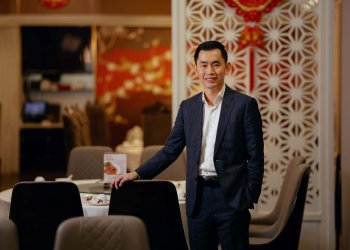
“Do not eat with your stomach. Eat with your mind.” It’s a phrase Hideki Kadota heard from the founder of the Royal Group decades ago, and it’s stuck with him through 35 years in the food business.
The meaning is simple but profound: dining isn’t just about whether something tastes good. It’s about understanding why a dish exists, what it expresses, and what you feel through all five senses. “It’s about engaging with the background, the ingredients, the intention behind every choice,” he smiles.

Now, as General Manager of Royal Sojitz Vietnam and the guiding force behind Ineya Roll & Teppan on Saigon’s bustling Xuan Thuy Street, Hideki is bringing that philosophy to Vietnam.
“This country,” he sighs contentedly, glancing out to the street. “There’s this vibrant food culture and strong energy,” he observes. “The streets are full of aromas, people gather all the time, and food is deeply woven into everyday life.” But there’s something else he sees – something just forming. “It feels like standing just before the dawn of a new stage for the food industry. That is how Vietnam feels to me right now,” he nods.
Honesty Over Performance
At Ineya’s teppan counter, there are no flaming onion volcanoes. No knife-juggling theatrics. And no chef spinning spatulas like a circus act.
“What we value most at Ineya’s TEPPAN is not flashy performance, but honesty toward the ingredients,” Hideki explains.

It’s a deliberate choice. Teppanyaki is often conflated with entertainment. “In Japan, teppanyaki broadly falls into two styles. One is just that – the casual and lively teppan-style approach enjoyed in everyday settings,” he elaborates.
“The other focuses on high-quality ingredients such as wagyu and seafood, where guests experience flavor, aroma, and texture with all five senses. Ineya’s TEPPAN belongs to the latter.”
The approach is stripped back: carefully selected A5 wagyu, fresh seafood flown in twice weekly, and minimal seasoning. “Rather than layering strong sauces or complex techniques, we use minimal seasoning. This allows the natural flavor of the ingredients to stand on their own.”

What guests experience isn’t spectacle – it’s transformation. “The sound, the aroma, the browning, and the way heat enters the ingredients. Guests can follow these changes with their own senses as the dish is finished.”
Two Expressions, One Philosophy
While the teppan counter commands attention with its live theater of transformation, Ineya Roll & Teppan’s sushi space offers a different kind of precision.
Here, the work is quieter – the clean slice of a knife through tuna, the careful composition of rice and fish, the deliberate arrangement of each piece. “We use tuna flown in twice a week and value balance across different cuts,” Hideki explains. The focus is on showcasing the ingredient in its purest form.

Both spaces – teppan and sushi – represent core expressions of Japanese cuisine. And both follow the same principle: minimal intervention, maximum respect for the ingredient.
“Alongside Italian and French restaurants, Ineya offers teppanyaki and sushi as two core expressions of Japanese cuisine. We value the way ingredients are handled, how dishes are composed, and the overall flow of the meal,” Hideki says.
The sushi space complements the teppan experience. Where one shows transformation in real time, the other presents it as a finished composition. Where one engages through sound and aroma, the other speaks through texture and temperature. Together, they offer a complete picture of Japanese culinary philosophy – honest, intentional, and deeply respectful of the ingredient.
Cooking As Meditation
It’s cooking as meditation. And in a dining scene as frenetic as Saigon’s, that calm feels radical.
At The Royal Group, they think about hospitality in three distinct layers, and the difference between them defines everything Ineya Roll & Teppan does. The first layer is tasks – bringing food and drinks as ordered. “It is the minimum responsibility of the job, but by itself, it does not stay in a guest’s memory.”
The second is service – noticing things before being asked, understanding timing, and acting slightly ahead of needs.
But the third layer is where Ineya Roll & Teppan lives: hospitality. “Hospitality means putting yourself in the guest’s position and thinking, ‘If this person were my family member or someone important to me, what would I do for them?'”

The examples are small but telling. Serving water before drink orders on a hot day, even though it might reduce beverage sales. Saying “It’s hot, please be careful” when serving hot dishes. Explaining not just what a dish is, but why it’s prepared that way, where the ingredients come from, why a particular wine or sake pairing works.
“We do not simply serve dishes. We explain the ingredients, why a dish is prepared in a certain way, and why a particular pairing is recommended. Sharing the story behind the food is also part of hospitality.”
It’s a philosophy that extends beyond the floor. “At the Royal Group, there is a very strong belief that the guest experience is everyone’s responsibility. If a mistake happens, we do not see it as an individual failure on the floor. We see it as a responsibility of those who design the system and provide training.”
Teppanyaki Is Transparency
Teppanyaki is unforgiving. Every movement is visible. The condition of the ingredients, how heat is applied, even the timing of each flip – there’s nowhere to hide.
“Exactly,” Hideki nods wholeheartedly. “The greatest appeal and challenge of teppanyaki is transparency. There is no room to hide.”
But that tension creates something special. “Because of that tension, we can also share the moment when the aroma rises and colors of the ingredients change with the guest. That shared experience is what makes teppanyaki special and rewarding.”

It requires a different skillset than traditional kitchen work. “You cannot rely on timers. You must watch the ingredients constantly and judge the timing yourself.”
And it demands a different mindset. “Standing at the teppan means always facing the guest and staying close. Hospitality is as important as technique.”
The proximity has led to memorable moments – some intentional, some not. Once, during a wagyu flambé, Hideki remembers the flame rose higher than expected and singed the chef’s eyebrows. Another time, a particularly energetic spiny lobster splashed water all the way to the counter when they were removing it from the tank. “Which surprised the guests, but we ended up laughing together.”
Logic, Not Intuition
Hideki’s approach to cooking wasn’t always this refined, he admits. If he could have dinner with himself from 37 years ago, when he was just starting out, he knows exactly what he’d say: “I would tell myself not to focus on making dishes look impressive. Instead, I would say to face the ingredients more honestly. For example, you don’t need more than three colors on a plate. What matters most is understanding the ingredients.”
“That means visiting farms for vegetables. It means learning about how the cattle were raised. When you understand where ingredients come from and truly think about them, they begin to express themselves differently on the plate,” Hideki assures us.

It’s a philosophy shaped by studying French cuisine and chefs like Kiyomi Mikuni and Joël Robuchon. “I came to understand that cooking is not only intuition. It is built on logic, repetition, and clear reasoning. There is always a reason something tastes good. There is also a reason when it does not. Nothing in cooking is accidental.”
An Obsession With Ingredients
At Ineya Roll & Teppan, that logic manifests in obsessive ingredient selection. “For beef, we use only purebred Japanese A5 wagyu. Even then, we do not rely on the grade alone. We check the marbling and texture ourselves and return it if the condition is not right.”
The same applies to seafood. The tuna is flown in twice weekly as well. And spiny lobsters are selected for their liveliness – “The more active it is, the better the texture and flavor after cooking.”

Quality Time
On Xuan Thuy Street, surrounded by coffee shops, bistros, and Vietnamese hotspots, Ineya Roll & Teppan offers something different: calm.
“If guests choose Ineya Roll & Teppan, I believe it is because they want to enjoy Japanese dining in a calm and thoughtful way, even in such a lively area,” Hideki says.
The environment is designed for it. Table height, seating distance, lighting, sound levels – all calibrated for comfort. “We hope Ineya Roll & Teppan becomes a place people naturally think of when they want to enjoy a slightly special evening.”

It’s what the Royal Group calls ‘quality time’ – the value of the time guests spend there. “Whether it is a family celebration, a meal with a loved one, or just an ordinary day, we want guests to leave thinking, ‘That was a good time.'”
The atmosphere is intentional. “We aim for a balance that is calm, but not too quiet – an atmosphere that also carries a sense of excitement. Many teppanyaki restaurants emphasize strong entertainment, but at Ineya Roll & Teppan we value being authentic. We want to properly convey teppanyaki as part of Japanese food culture.”
Rather than spectacle, Ineya Roll & Teppan wants guests to feel that “authentic food is truly delicious.”
Building Culture, Not Just Training
Hideki sees something in Vietnam that reminds him of Japan in the 1970s – a moment when dining began to shift from necessity to experience. “Restaurants evolved from places that simply filled the stomach into spaces where people gathered, spent time, and reset their minds.”

Vietnam is at that threshold now. “Within the Royal Group, many Vietnamese staff members are seriously committed to the industry. It’s not just about training – it’s about building a culture where hospitality becomes instinctive. Where staff look happy and engaged, even when they’re busy. Where the tone of voice stays calm and pleasant. And where guests feel cared for, not serviced.”
“I like restaurants where the staff look genuinely happy,” Hideki says. “Even when busy, they are not running, angry, or visibly stressed. That kind of environment is exactly what we aim to create at Ineya Roll & Teppan.”
The Perfect Meal
If Hideki came as a diner, he’d order the TEPPAN TAKE Course, he reckons – not the elaborate Matsu, because “it leaves a little room at the end.” In that remaining space, he’d finish with the special three-piece roll sushi. “For me, that balance feels perfect.”
For sake, he’d choose Kubota Manju – “subtle and elegant.” But honestly? “I feel wine pairs better with teppanyaki. Starting with champagne, then moving to a crisp white wine for spiny lobster, and a Burgundy red for wagyu.”
The philosophy is consistent: “Drinks do not change the food. They gently elevate it.” It’s the same principle that guides everything at Ineya Roll & Teppan – don’t overpower, don’t perform, don’t distract. Let the ingredient speak. Let the moment breathe. Let hospitality feel natural, not forced.
It’s a place to eat with your mind, not just your stomach. And after 35 years in the business, Hideki has learned that’s the only way a meal stays with you.



 Wink Hotels' is a new kind of Vietnamese hotel made for the modern traveler and ready to take on the world.