

 The red color seeps into his hands when Jérôme Aguirre touches the grape skins just before harvest. Right then, he knows they’re ready. “This is very emotional for me,” he says, pausing. “It’s a goosebumps moment.” The kind of moment that still happens after 25 years in the wine business. The kind that reminds him why, despite directing 12 million bottles annually for Mouton Cadet, the number one best-selling premium wine brand in France, he insists: “I’m just a farmer.”
“Right before harvest, when I touch the skin of the grapes with my hand, their red color seeps into them, and I know they’re ready,” Jérôme sometimes has goosebumps moments like this, when the connection becomes tangible.
A Farmer And A Winemaker In The Most Personal Sense
That’s because he really is a farmer and a winemaker in the most personal sense. He has his own small property with his wife, where he makes wine during his downtime. “My last goosebumps feeling was when we were at home, when we tested the wine we’ve made there,” he nods appreciatively.
It’s a reminder that for all the scale and sophistication of Mouton Cadet’s operations, winemaking remains an intimate act. The same hands that guide 150 winegrowers across Bordeaux still get stained with grape juice at home. The same palate that blends millions of bottles still finds joy in tasting a single vat with his wife.
It’s Different
“I hope I will never see robots in a vineyard. When you touch a vine, when you prune a vine, it’s different. Very sensitive,” he smiles at the joy of it.
It’s this connection – between hand and grape, between soil and soul – that defines his philosophy. After all, “I’m just a farmer,” he keeps reminding us. Despite that, the Head Winemaker and Director of Mouton Cadet is responsible for 12 million bottles coming from the iconic Bordeaux brand annually.

Still, he really means it. He’s acutely aware that at whatever scale it happens, winemaking begins and ends with the land. And his approach to Mouton Cadet‘s 95-year legacy is rooted in something his grandfather taught him. “When the sun is out, you need to work. When it’s raining, you can stay at home. Saturdays and Sundays don’t exist. And this is farming.”
Working Intimately With Each Winegrower
Considering his close connection to the 150 winegrowers “who we visit weekly” that form the collective behind Mouton Cadet, it’s not surprising he feels a close connection to the Bordeaux terroir. “We have very strong links with the winegrowers,” he nods.
Unlike traditional cooperatives, Jérôme’s team works intimately with each winegrowers, managing everything from pruning to harvest, and even developing a custom app to share market insights and technical guidance.
 The scale of the brand is a safety net. It gives winegrowers the confidence to undertake the transition to organic certification. “When you do the organic conversion, it’s very stressful,” Jérôme explains. “We can be present and I think we are more secure doing this.” But the relationship is reciprocal. “We learn with our winegrowers,” he explains.
And You Continue
Together, they’re acutely aware – for all the tech-driven approaches, the accrued and shared knowledge, and the strength their community offers – that they’re at the mercy of nature. “Before the harvest, you have a big storm and it destroys everything. You lose everything. What do you do? When you wake up the day after. And you continue.”
The challenges are not only environmental.
Market pressures shift, regulations tighten, consumer tastes evolve, and managing 150 independent winegrowers across Bordeaux while maintaining consistency at scale requires more than just relying on the weather.
Jérôme is clear about the problem: “I think there is an overproduction compared to demand, and that there are too many low‑quality wines on the market.”
 In 2023, the French government funded the destruction of 40,000 hectares of vineyards because the wine they produced couldn’t compete. It wasn’t a crisis of quality for the good producers. It was a crisis of volume. Cheap wine flooded the market while global consumption dropped, particularly among younger drinkers who’ve shifted to spirits, beer, or nothing at all.
Bordeaux, once untouchable, had been hit hardest. For Mouton Cadet‘s winegrowers, who are paid above market rates and work under three-year contracts, the pressure was existential. “Make wine worth making, or don’t make it at all,” Jérôme emphasizes.
Preserve Nature In Every Step
The key, he reckons, is balance. “And the balanced thing is to preserve nature in each step,” he says. It’s the farmer in him talking again – the one his grandfather raised and the one who still gets emotional touching grape skins before harvest.
There’s generational shifts in wine-making too. The next generation aren’t always keen to pick up the baton. “Look, it’s romantic,” he smiles, “but there’s a price to be paid to live what looks like a romantic life.”
The resilience he and the winegrowers in the collective have earned can perturb next generation wine makers. “I’ve learned with nature to be more resilient and that working in the wine business, in the farming business, has helped me a lot personally in terms of resilience. But does it suit everyone?” he asks, already knowing the answer.
Boldly Reinterpreting Tradition
But, around the time Bordeaux wines had that moment of introspection, the now 95-year-old Mouton Cadet entered into its biggest innovation in its history.
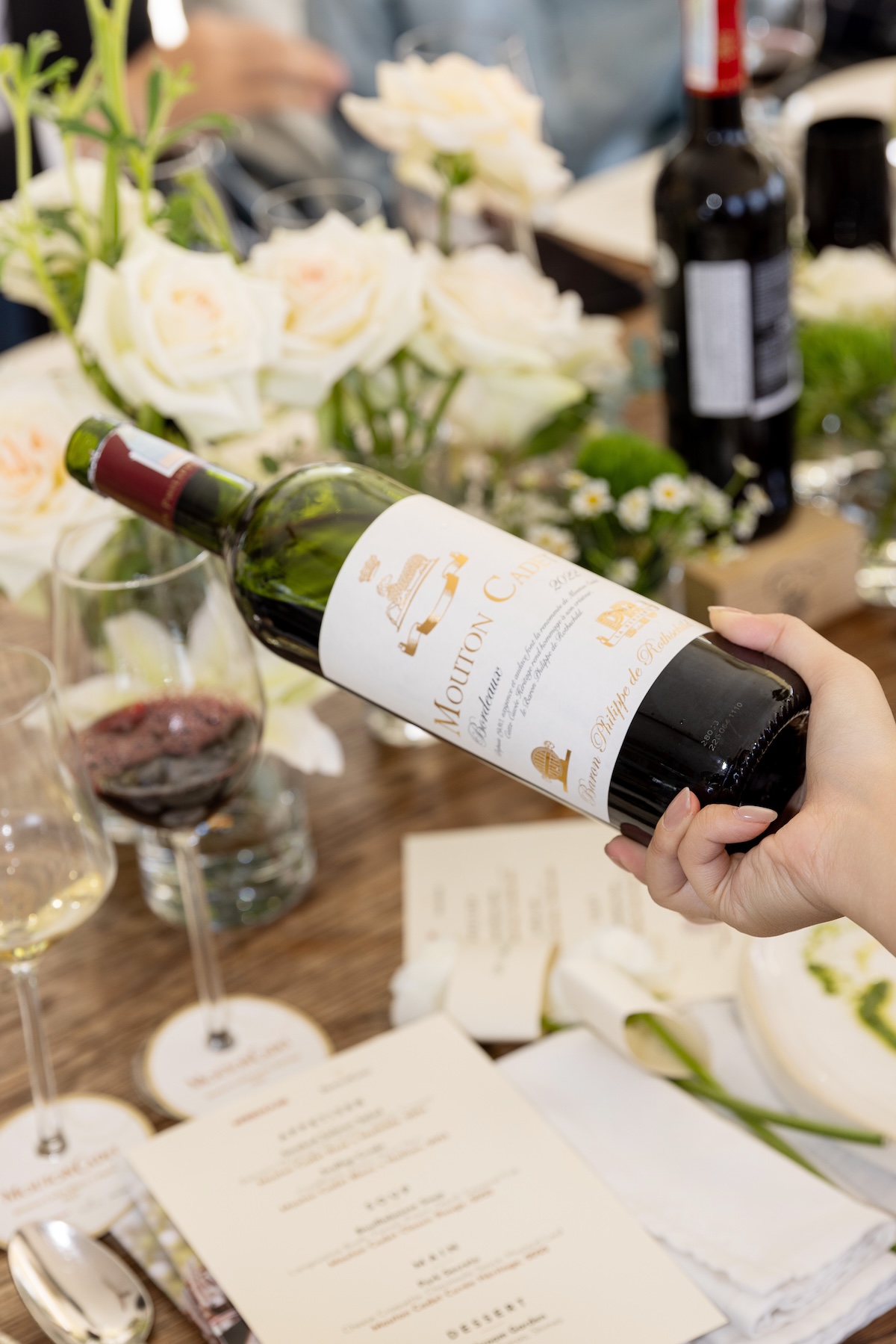
Its ‘Fresh Collection’ – including the labels Nathán, Mathilde, and Pierre – represented a generational shift. Created by Baron Philippe de Rothschild’s great-grandchildren (Mathilde Sereys de Rothschild, Nathan Sereys de Rothschild, and Pierre Ögren de Rothschild), all at age 28 – the same age their great-grandfather was when he revolutionized Bordeaux in 1930 – these wines boldly reinterpreted tradition for contemporary life. All three organic, vegan, and designed to be enjoyed chilled. Even the red.
Mouton Cadet Rouge x Pierre is the rule-breaker. A 100% Merlot red wine served at 8-10°C from an ice bucket, it uses a hybrid vinification technique combining rosé and red methods to preserve fruit radiance while creating a light, succulent body. It’s designed for aperitifs, casual dining, and serving to guests who claim they “don’t like red wine.”

“You can put red wine in the fridge, but if you put the bottle in the fridge, the balance is different. The aromatic expression is different,” Jérôme explains. “We have selected some plots to ensure an interesting profile.”
Mouton Cadet Blanc x Nathan is a 100% Sauvignon Blanc – airy, emphatically aromatic, with candied citrus, boxwood, and white blossom. Nathan, a student at the Lee Strasberg Theatre and Film Institute in New York, wanted a wine that “takes wing like a great piece of music.” And the organic and vegan certifications were non-negotiable.
Finally, the Mouton Cadet Rosé x Mathilde is 100% Merlot, pale pink, bursting with raspberry, redcurrant, and lychee. Mathilde, who led the trilogy’s creation, wanted something “as refreshing as Atlantic Ocean surf – a wine for summer spontaneity without pretense.”
Shall We Have A Glass Of Wine?
“We are a part of a laboratory,” Jérôme admits. “It’s interesting. You are learning every time. You build, you rebuild.”
Beyond the Fresh Collection, Mouton Cadet‘s core range – Rouge, Blanc, and Rosé – remains the accessible entry point to Bordeaux, while the Reserve range offers appellation-specific wines from Pauillac, Médoc, Margaux, and Graves. Each tier serves a purpose, but the Mouton Cadet philosophy, mixed with his impassioned farmer’s philosophy is ingrained like DNA.
In Vietnam, Annam Group & Warehouse – the exclusive strategic partners of Baron Philippe de Rothschild – brings Mouton Cadet with the same philosophy intact. Sustainability, quality and environmental responsibility.

“Shall we have a glass of wine?” Jérôme, the farmer, the winemaker, and the Head Winemaker and Director of Mouton Cadet who’s responsible for 12 million bottles for the number one best-selling premium wine brand in France, asks. Of course we should. Because wine, like the collective behind Mouton Cadet, gains everything in the sharing.