


 Seoul is buzzing. For the second consecutive year, Asia’s 50 Best Restaurants has descended upon the Korean capital, bringing with it the continent’s culinary elite, international media, and the unmistakable energy of a city cementing its place on the global gastronomic map. This isn’t happenstance. This is strategic. This is Hansik’s coming-out party.
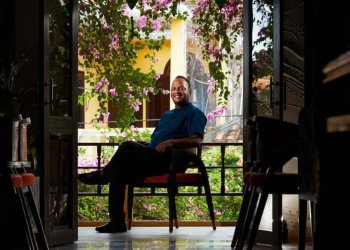
“I’m more used to taking just one chef around here,” Joseph squints back along the long line of journalists, chefs and friends snaking down Gyeongdong Market’s aisle as an overzealous cameraman from KBS barges past. This isn’t the quiet industry excursion he prefers – it’s morphed into something between a culinary parade and media circus.
A Relentless Marathon Of Collaborative Dinners, Media Interviews, And Industry Networking
For someone who thrives in the controlled precision of a two-starred kitchen, the chaos seems to spark an unexpected glint in his eye – equal parts discomfort and delight. “I’ve only had two-hours sleep the last two nights,” he admits, which might also be the reason. Asia’s 50 Best Restaurants week is a relentless marathon of collaborative dinners, media interviews, and industry networking that leaves even the most seasoned chefs sleep-deprived.
Normally, this is Joseph Lidgerwood’s Seoul sanctuary – the place he takes every visiting chef who flies in for four-hands dinners at his newly minted two-MICHELIN-starred Evett. It’s a restaurant where Korean heritage isn’t merely respected but boldly reimagined. And Gyeongdong Market is where Joseph finds out what’s in season.

The Convergence Of Cameras, Culinary Curiosity, And Commerce
We walk past stalls full of ginseng, fermented pastes, and chilis and other vegetables that he picks up – like tart mugwort leaves and crunchy cucumber peppers – and passes them around. Then, down a vertiginous sweep of stairs he leads us to Andongjip Sonkalguksi, a popular restaurant serving Kal-guksu – a noodle dish consisting of handmade, knife-cut wheat flour noodles served in a large bowl filled with steaming hot broth.
Its owner, Kim Mi-ryeong became famous thanks to the Netflix cooking competition show Culinary Class Wars. “You won’t be able to get a table in an hour or two,” Joseph warns.
This convergence of cameras, culinary curiosity, and commerce is no accident. This is Hansik at work – Korea’s deliberate, decades-long campaign to elevate its cuisine to global prominence. What began in 2009 as a government initiative has evolved into a sophisticated strategy blending traditional ingredients with international recognition, social media visibility, and strategic media partnerships.
The Netflix effect, celebrity chefs, and MICHELIN’s growing interest have transformed these market explorations from private chef rituals into content-worthy moments. And the market, once merely his ingredient source, now serves as a stage for showcasing Korean food culture to the world.
Another Unexpected Hansik Ambassador
Like Joseph, Fabrizio Ferrari might not fit the mold of a typical Hansik ambassador. The Italian-born chef maintained a MICHELIN star, like a carefully watched pot of ragu, for 15 years at his family restaurant before trading European acclaim for a classroom in Daejeon.
These days, he’s known to Korean audiences as ‘Chef Fabri,’ television’s unexpected Italian authority on Korean cuisine. His 2016 victory at a Korean food competition hosted by the Korean Consulate in Milan catapulted him into KBS’s Global Taste of Korea. This led to three months on the show ‘Hansik Battle’ alongside researcher Lee Young-sook — who became “like a second mother” in his Korean food education — and celebrity chef Paik Jong-won. By 2019, he was all in, moving to South Korea and giving lectures at Woosong University, while regularly appearing on TV shows.
Fabrizio represents a new kind of culinary diplomat in Korea’s strategic Hansik promotion – the foreign expert who approaches traditional Korean cooking with both professional technique and genuine reverence. His television appearances aren’t merely entertainment; they’re calculated components of Korea’s broader soft power strategy. And for Ferrari himself, kimchi-making has become spiritual practice, connecting him to “the ancient history of Korea.”

Swapping A Room Full Of Undergraduates For A Hall Full Of The Best Chefs In Asia
But right now, he’s a little flustered. “Where was I,” he mumbles, shuffling his papers, while the slides behind him carousel through a greatest moments reel of his TV appearances. He’s the last speaker at Asia’s 50 Best Restaurants 2025. #50BestTalks. And he’s understandably nervous because this time he’s swapped a room full of undergraduates for a hall full of the best chefs in Asia as his audience. At a table next to the stage, there’s Chef Pam, from Potong Restaurant in Bangkok, Junghyun Park and his wife Ellia, from Atomix, in New York, there’s Vicky Cheng, of Wing and VEA, and Jay Khan, who’s not a chef. Still, his bar Coa Hong Kong held the title of Asia’s 50 Best Bars no.1 for an unrivaled three consecutive years. All of them – except Junghyun Park who’s here to support Ellia – have spoken before Fabrizio took the stage and are listening attentively to his story.
“Over the last ten years, TV cooking shows have featured lots on Western television,” he continues, gathering himself. Asia hasn’t been immune to the trend. “It’s boomed here too,” he adds, “but in a different, refreshing way – in fact, thanks to a different approach towards food storytelling, it has helped shape the perception of Asian cuisine abroad, and to introduce Asian flavors to new audiences.”
A Powerful Combination
“So, what’s the secret of Korean TV food shows?” he asks the audience. “While they’re real – and they’re brutally real – they seduce you with that reality while delivering education and awareness. It’s a powerful combination.”
Ten minutes from Myeongdong’s consumer chaos is Korea House. There, Chef Cho Hee-sook, ‘the Godmother of Hansik,’ is getting back to basics, even though at her restaurant, Hansikgonggan, she blends tradition with innovation. On normal days, Korea House is a center dedicated to promoting traditional Korean culture and customs right in the heart of Seoul. Today, they’re hosting a Hansik Market in the courtyard, talks in the lecture theatre, and this cooking demonstration for local and international media.
When Cho Hee-sook began her culinary journey in 1983, Korean cuisine wasn’t considered fine dining material. Seoul’s high-end food scene belonged exclusively to French and Italian restaurants in international hotels. Korean food was dismissed as “second-class” – something that “belonged to the older generation, not innovative.” Cho saw it differently.

Quietly Revolutionizing Korean Cuisine
For nearly four decades, she worked behind the scenes, quietly revolutionizing how her country’s cuisine was perceived. She moved through prestigious positions: chef de cuisine at Grand Intercontinental Hotel Seoul, resident chef for South Korea’s Ambassador in Washington, professor at Woosong University – the same university Fabrizio lectures at.
Only in 2019 did Cho Hee-sook finally step into the spotlight with Hansikgonggan, her intimate restaurant nestled beside Seoul’s ancient Changdeok Palace. Just one year later, Asia’s 50 Best Restaurants named her Asia’s Best Female Chef. The recognition left her stunned. “I thought they had emailed the wrong person,” she admitted at the time. “I always thought these awards were for young chefs, not for someone like me, who already spent her entire life in the kitchen.”
Cho’s influence extends far beyond her own kitchen. Her former students include Mingoo Kang of Mingles and Junghyun Park of New York’s Atomix. Park has called her “an irreplaceable figure” whose “tireless work was and is essential in connecting generations of chefs and advancing Korean food globally.”
But today, she’s keeping it simple. “I really want you to try the original taste of Korean food,” she smiles as she demonstrates how the cuisine uses fermented soybean pastes – like doenjang, gochujang and kanjang – as seasoning.
Showcasing Korea’s Recipe For Soft Power
As she does so, Cho Hee-sook reveals more than just technique. She’s showcasing Korea’s recipe for culinary soft power: one part unwavering tradition, two parts strategic innovation, and a generous helping of international validation. This formula has transformed Korean cuisine from “second-class” hotel afterthought to global phenomenon in a single generation.
Foreign chefs like Joseph Lidgerwood and Fabrizio Ferrari serve as crucial ingredients – outsiders whose expertise legitimizes Hansik to international audiences while their genuine reverence preserves its authenticity. And television has become the heat that accelerates cultural diffusion, turning market visits into content and cooking techniques into entertainment. And institutions from The World’s 50 Best, to MICHELIN and Netflix have become the plating – the presentation that signals to the world that this cuisine deserves attention.