



There is a brand of Scottish spirits that cannot legally be called Scotch whisky, comes in a paper bag, and traces its provenance not to a distillery or a region but to a precise set of GPS coordinates at the bottom of a loch. It’s called Domhayn. And it’s undoubtedly the world’s deepest dram.
James Patterson was watching swimmers climbing out of Loch Ness when it came to him. They had, as Scots do, brought a dram for the occasion — a small sip to stave off the cold. Patterson, a civil engineer, watched the bottle and thought: what if the whisky goes in too?
Twenty years of research later, that thought has become Domhayn — from the Gaelic word for deep — and one of the more genuinely strange stories in spirits right now.
The premise is straightforward. A spirit-filled wooden cask is submerged to the depths of Loch Ness, approximately 214 meters beneath the surface. The extreme hydrostatic pressure at that depth triggers a compression and decompression cycle that drives spirit deeper into the wood and pulls it back out again, altering the molecular profile of the liquid in ways that conventional maturation cannot replicate. Domhayn call this ‘baromorphosis’ — pressure-shaped — and the name is accurate. Below 200 meters, wood-trapped air is compressed to one twentieth of its original volume. On ascent, it expands back. The spirit moves with it, each time, differently.
A Revolution In Spirits Production
Samples were tested by the Department of Chemistry at Oxford University using chromatography coupled to mass spectrometry. The results showed a measurably different molecular composition in the processed samples, confirming that something real is happening at the chemical level. Whether that constitutes a revolution in spirits production or an exceptionally well-documented experiment is still being argued. The answer is probably both.
There is a practical curiosity buried in the process. Each cask can only withstand one dive before the pressure permanently alters it. There are no second chances and no control runs on the same oak. Whatever the submersion does, it does once. It is a one-way door — which makes every bottle a document of a single, unrepeatable event.
A Three-Meter Square Of Loch Bed
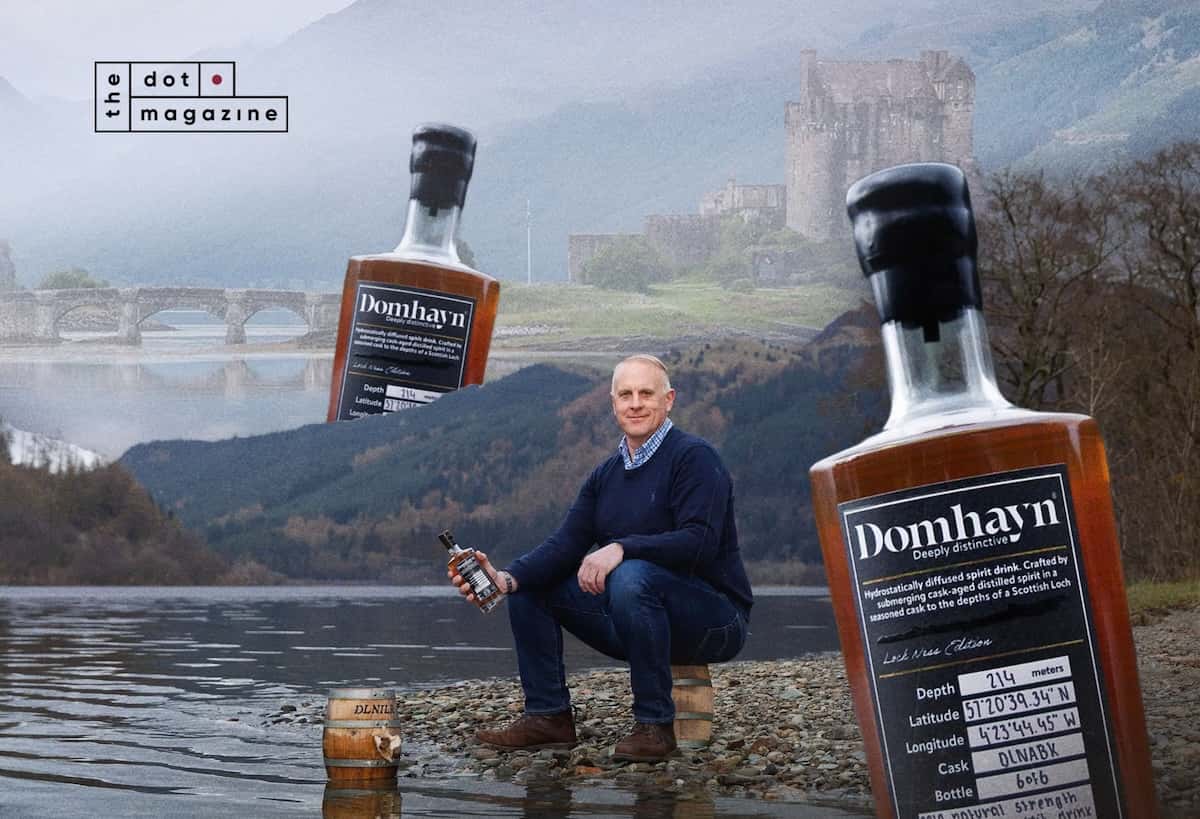
Domhayn’s inaugural release came from cask DLNABK, submerged on 14 February 2025 — Valentine’s Day, which feels either poetic or deeply Scottish. The spirit inside was a 2010 single malt barley spirit, bottled at 55.5% ABV. Six bottles exist. One sold at Whisky Auctioneer for £850. Each comes with the precise GPS coordinates of where its cask rested on the loch bed, handwritten on the bottle. Most spirits trace their provenance to a region, a distillery or a cask number. These trace theirs to a three-meter square of loch bed, filmed on the way down.
The bottle itself arrives in a paper bag — deliberately, defiantly unpretentious, a wee doff-of-the-hat to boundary pushers, as the brand puts it. Select editions are presented in a leather-lined, wax-cotton bag made in collaboration with Canadian fashion designer Charlotte McKeough, whose work has appeared at MoMA, and Paul Smith and Vogue. The contrast is the point. The packaging says nothing. What happened to make the liquid inside is everything.
Existing In A Grey Area
The regulatory situation is its own kind of story. Because Domhayn’s submersion method doesn’t fit within the legal definition of Scotch whisky — the process alters the molecular profile in ways the existing category regulations don’t account for — the spirit cannot legally be called whisky at all. It exists in a grey area: a spirit that begins its life as whisky and becomes something the industry has no name for yet. The rules were written before anyone thought to ask the question.
Now Patterson is asking a bigger one. Having proven that 200 meters changes the liquid, he wants to know what 1,830 meters does.
Entering The Abyss
The new project targets 1,000 fathoms — the deep-sea threshold that 19th-century ocean explorers including James Clark Ross described as the abyss. The plan runs in two phases: first, controlled onshore tests using a hydrostatic pressure chamber to safely replicate those conditions and monitor how the cask behaves as pressure builds. If that works, an open-ocean experiment follows. A Kickstarter campaign running from 9 April to 12 May 2026 is funding the attempt.
The pressure at 1,830 meters is approximately 184 bar — nearly ten times what the Loch Ness casks experienced. What that does to the wood structure, to the interaction between spirit and oak, to the flavour of whatever comes out the other side, nobody knows.
Patterson is careful not to overclaim. The language he uses is that of curiosity: wanting to see how far the effect goes, whether Loch Ness was scratching the surface. The Domhayn story is about a question that had never been asked seriously before, and a founder with the engineering background and the stubbornness to pursue it properly. The Oxford verification was not marketing. It was Patterson making sure the thing he thought was happening was actually happening.
The Domhayn Whisky Project Matters
Whether the abyss experiment produces a revelatory spirit, a scientifically fascinating failure, or something in between, the project matters for what it represents. The spirits world is not short of innovation theatre — limited releases, unusual casks, eye-catching collaborations. Domhayn is doing something different: it is doing actual research, in public, with results that can be examined. As E.O. Wilson put it: there is no better high than discovery. Patterson seems to agree.