


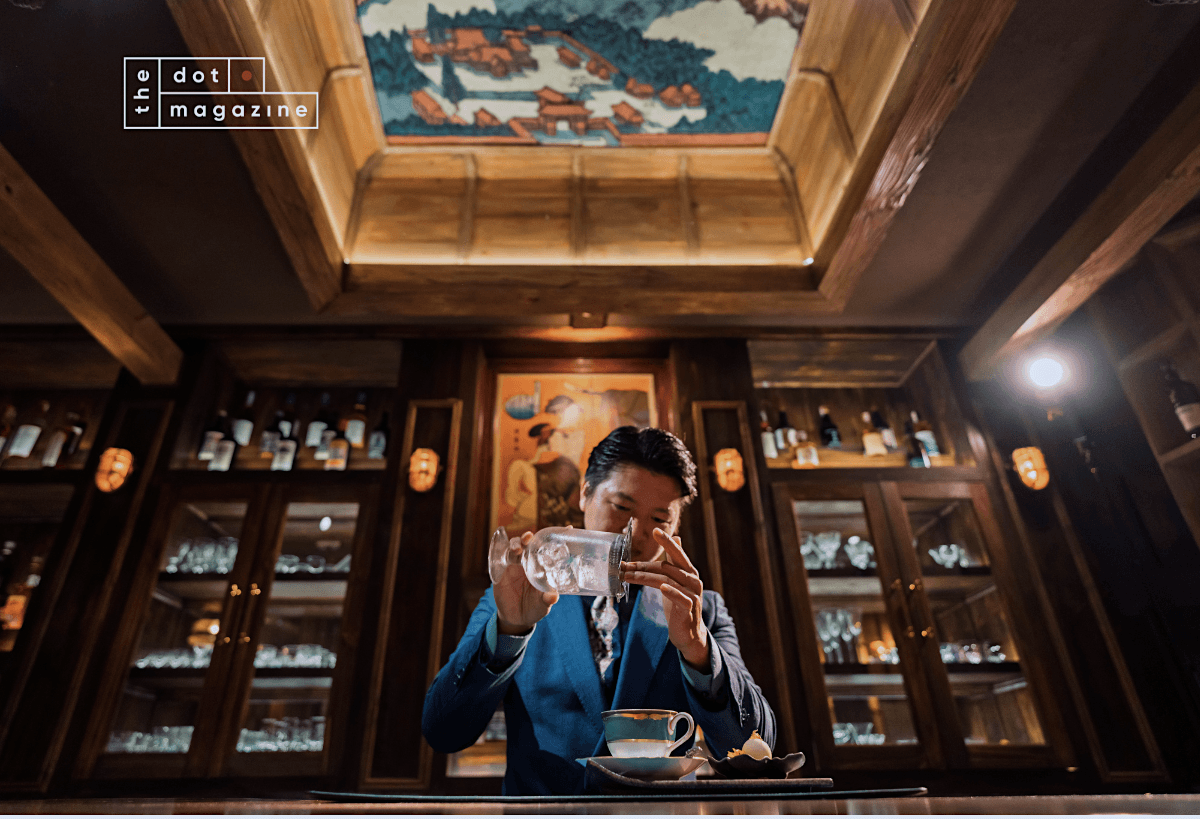
 Down an alley off Saigon’s Nguyen Thi Minh Khai, a plain sign in black type does nothing to prepare you for what’s on the other side of the door. An irori is a Japanese hearth built into the floor – the place in old houses where the whole everyone would gather. There’s one in the centre of House of Irori too. There’s a sign on the way in that reminds you to ‘please, make yourself at home’ – as if you weren’t doing that already.
“It’s magnetic, man,” Khoi nods, as Makoto Matsushita’s ‘September Rain’ drifts into Hiromi Go’s ‘Careless Whisper.’ “It’s not the short version people know, it’s the extended version,” he whispers beneath the music.
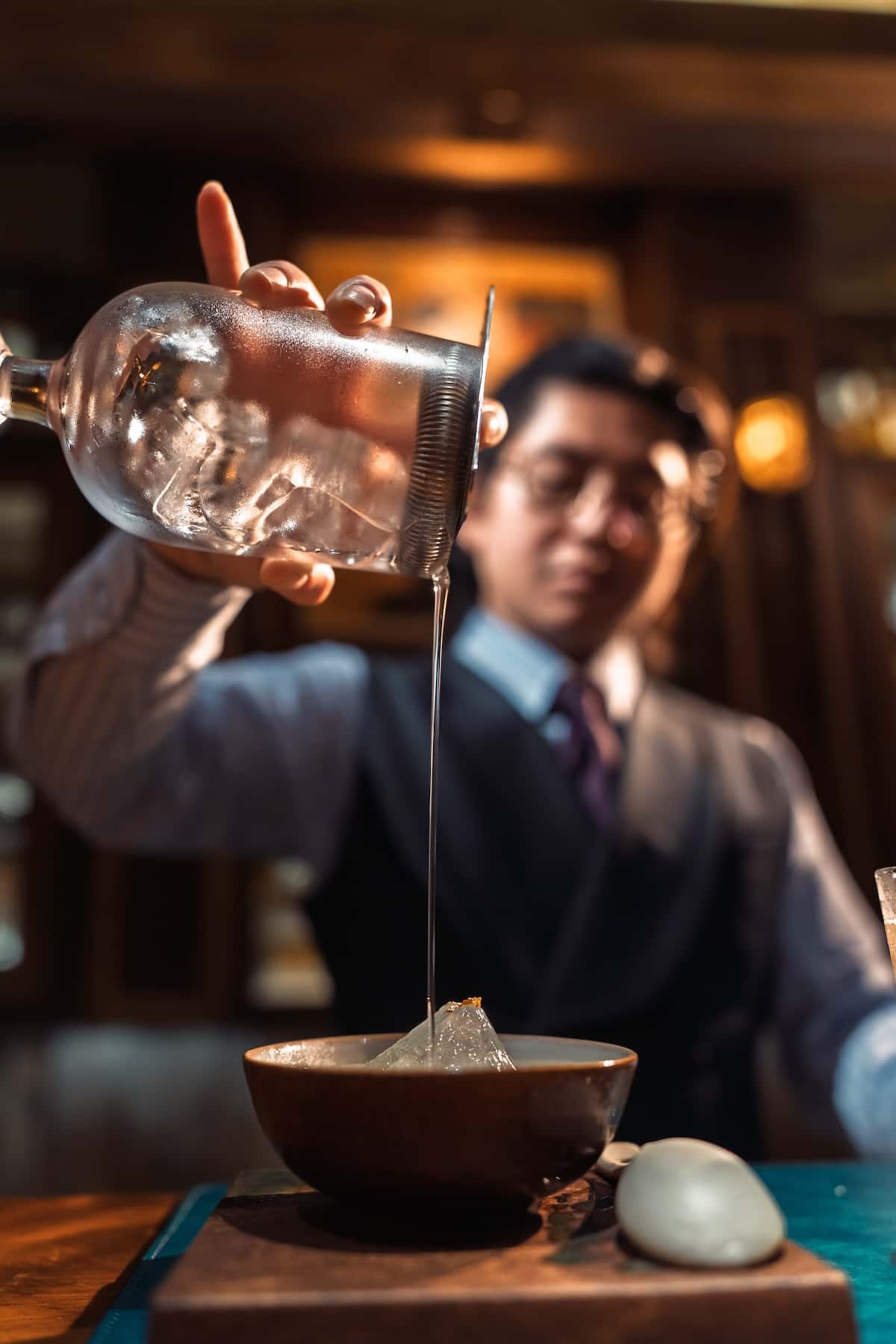
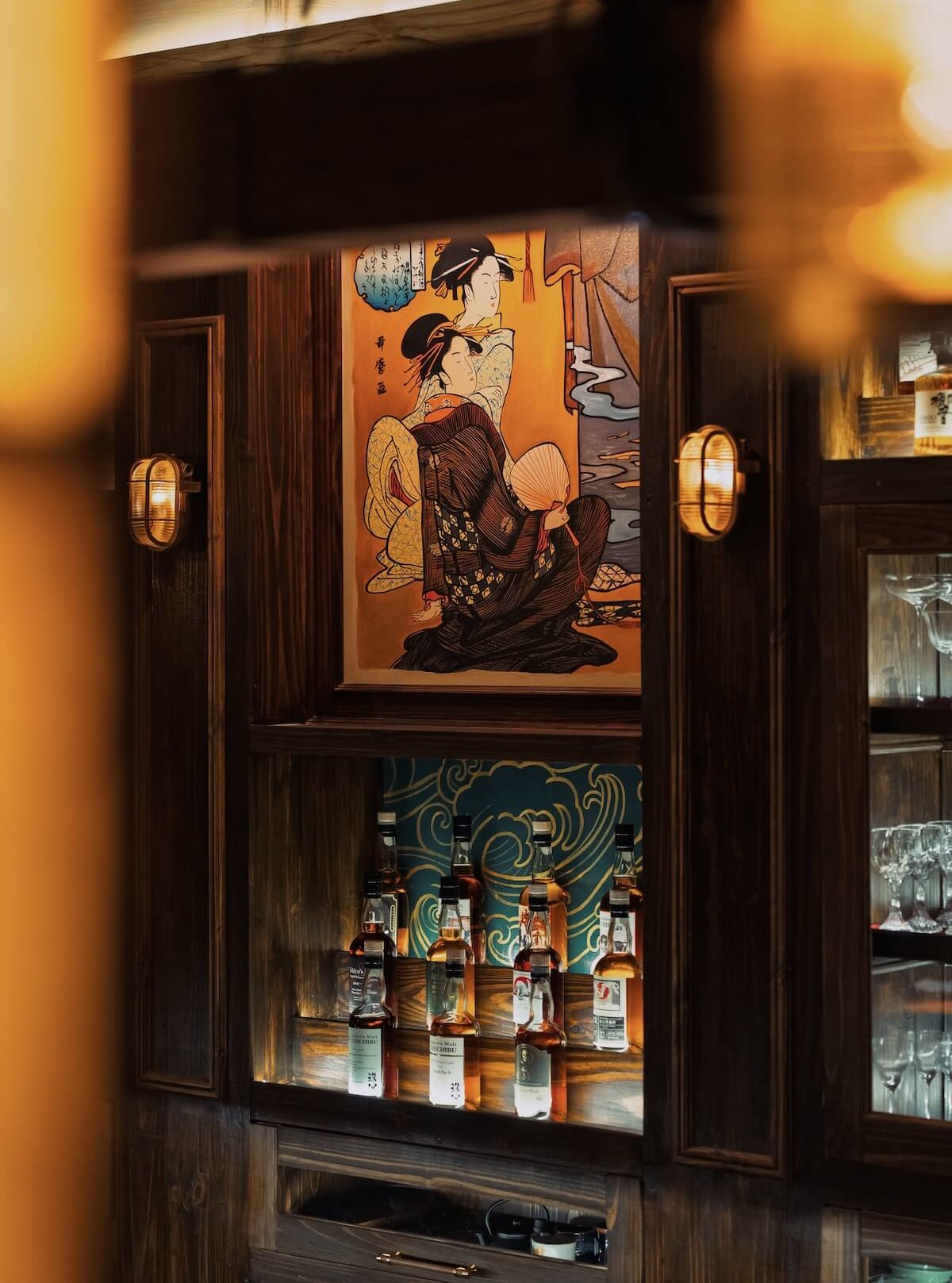
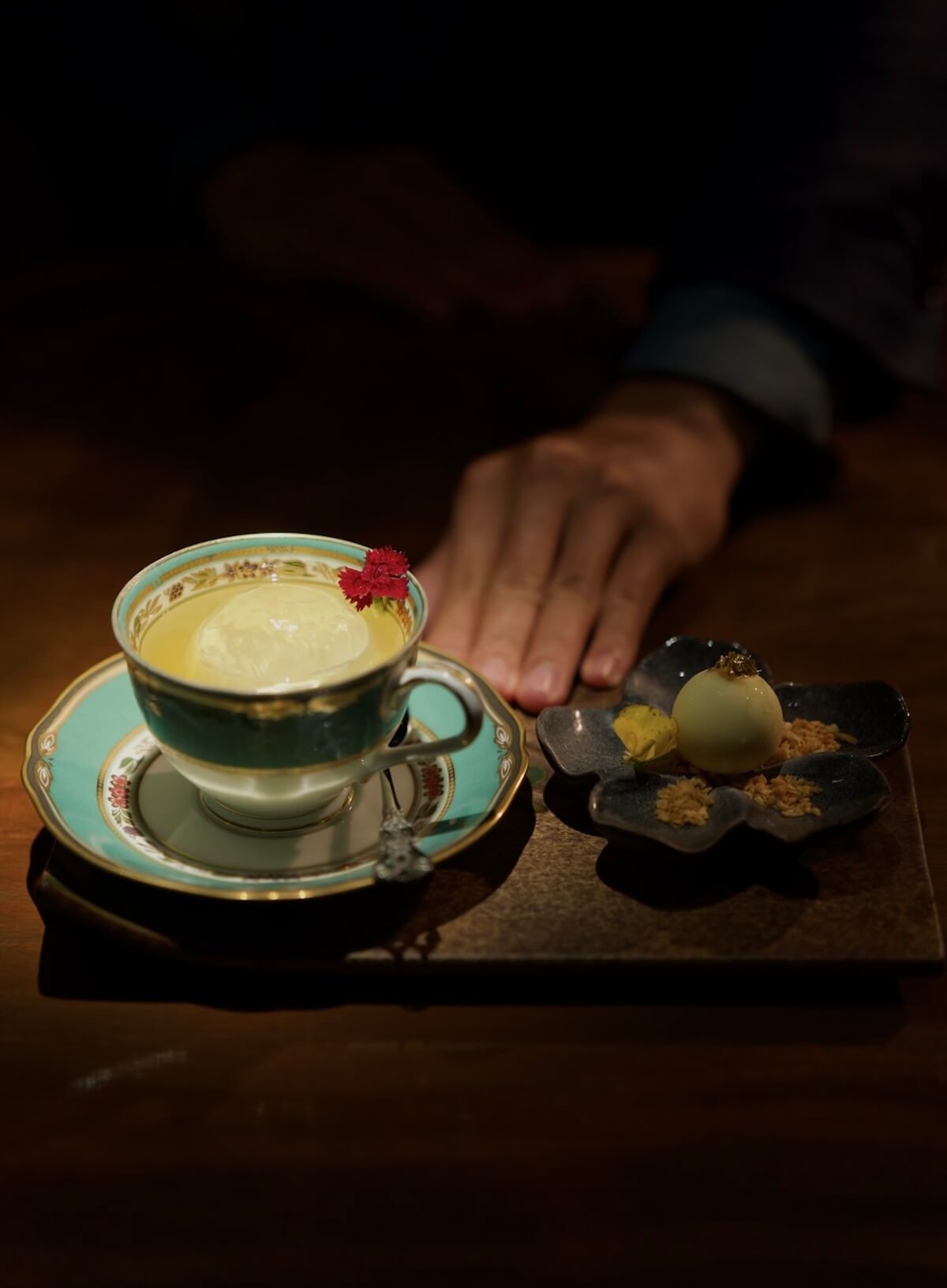
That attention to detail runs through the whole concept. The bar counter, for example, is a note brighter than you’d expect – a deliberate choice, meant to close the distance between bartender and guest rather than let dim lighting do that work instead. Most of the Chichibu on the back bar is single cask, hunted down bottle by bottle on trips to Japan. Even the Velvet Hearth, from the Signature Cocktail list, swaps mochi rice balls for yogurt balls, eaten with an ornate spoon. The Noritake china was picked out piece by piece in Japan. And the wooden interior was finished on site rather than pre-built – partly because of the awkward staircase – partly so its grain and texture could be adjusted by hand until it matched what was in their heads.
Even the hot towel at the door and the miso soup on the way out are bookends, lifted straight from ryokan custom. They’re presented here because the team insists the feeling of arriving and leaving should matter as much as anything in between.
Khoi’s attention drifts to the far end of the room, to a locked cupboard – the Cabinet of Curiosities, its name lettered in gold across the top.
Arriving. Leaving. And Everything In Between.
House of Irori comes from the people behind House of Merlin. Wanderlust and magic there, swapped here for hearth and home. More Houses are coming, the team says, though the count depends on who’s telling it, and the themes aren’t fixed yet either.
“Oh, that?” he says nonchalantly, glancing over at the lock. “If you can open it you get what’s inside,” he adds mischievously.
The outside feels a world away already. The concept captures you immediately down this alley off Nguyen Thi Minh Khai. There’s a plain vertical sign. On it, black type on white spells out the bar’s name, House of Irori, and a small square woodblock emblem above it showing a fire and a hearth viewed from above.
An irori is a traditional Japanese sunken hearth – a square pit cut into the floor of old farmhouses, the fireplace set directly into the ground and the entire household gathered round it for cooking, warmth and talk.
Below the sign there’s a noren curtain, printed with the same emblem and a bottle silhouette, hinting at the illicit thrills within. The doorway below swallows you up immediately.
Inside, the staircase doubles back on itself, then disappears upward under a hand-painted ceiling of storm clouds. There’s a red paper lantern. A carved octopus panel. And a wave-print curtain. And strings of paper lanterns are brushed with calligraphy.
Down the corridor, more Japanese ephemera evokes Japan’s Taisho and early Showa eras (roughly the period between the 1920s and 1940s), the country’s jazz age when moga and mobo – modern girls, modern boys – swapped kimono for bobbed hair, cigarettes and imported gin, and Art Deco started creeping into sake labels and shopfront signage.
They’d probably order a ‘Radiant Grace’ – aroma rum, pear, jujube and shiso cordial, cut with cucumber, Lillet blanc and orange bitters. Delicate but strong enough to outlast the jazz record that’s playing.
Or a drink that’s become a bestseller already, House of Irori’s ‘Lullaby of Life,’ in which chamomile rum meets fino sherry. Added to that, Scarlet Menta amaro takes it in a bitter-herbal direction rather than the sweetness you might expect.
Or, another of the signatures, like ‘The Blue Hour,’ the bar’s cocktail tinged with the melancholy of twilight, or l’heure bleue. It’s smoky and smoldering, as Lapsang Souchong meets bourbon that turns the whiskey’s own smokiness up a few satisfying notches. Some truffle adds earthiness – grounding it, right as the coils of smoke escape the cloche.
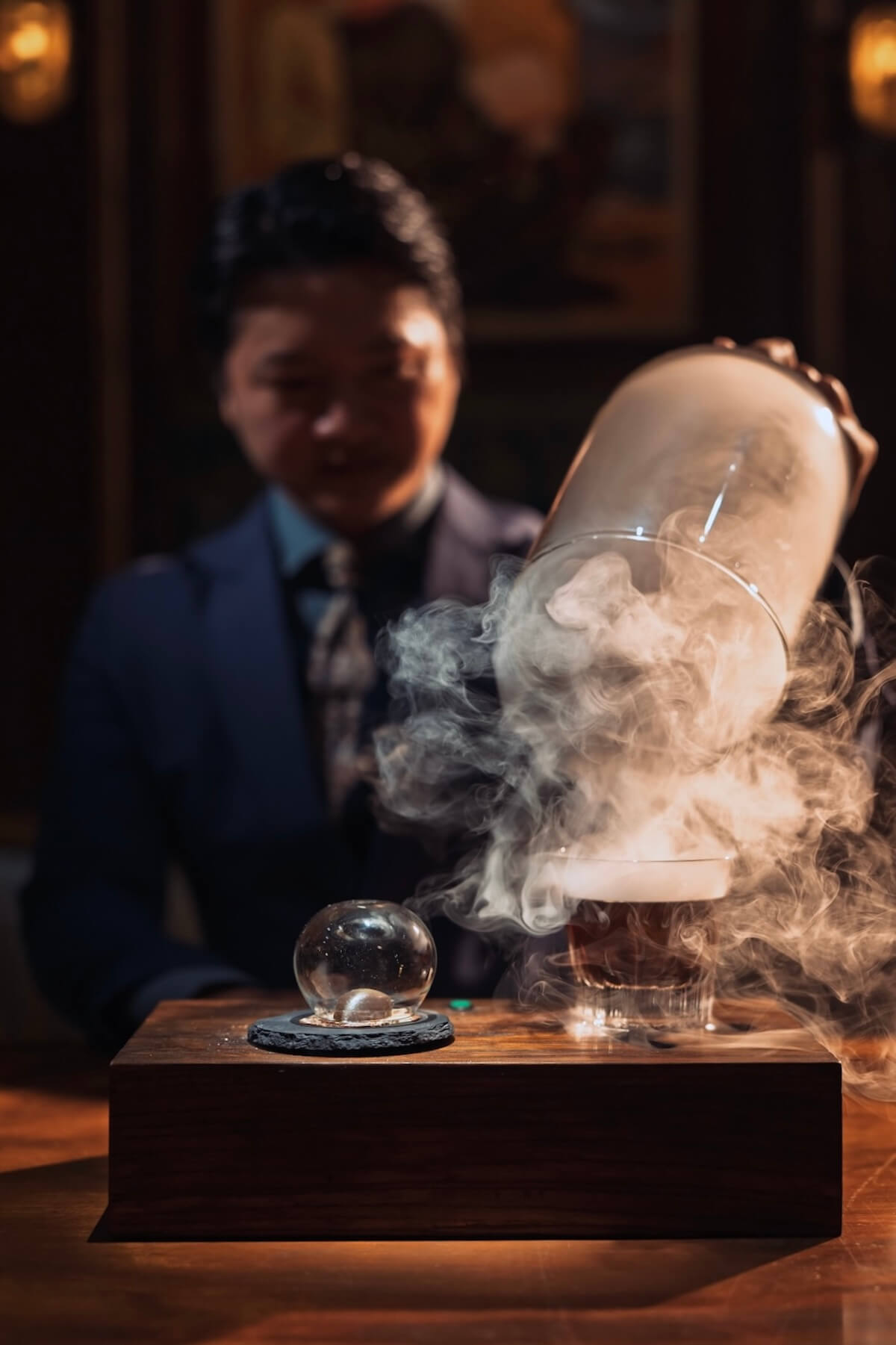
That Warm Feeling At House Of Irori
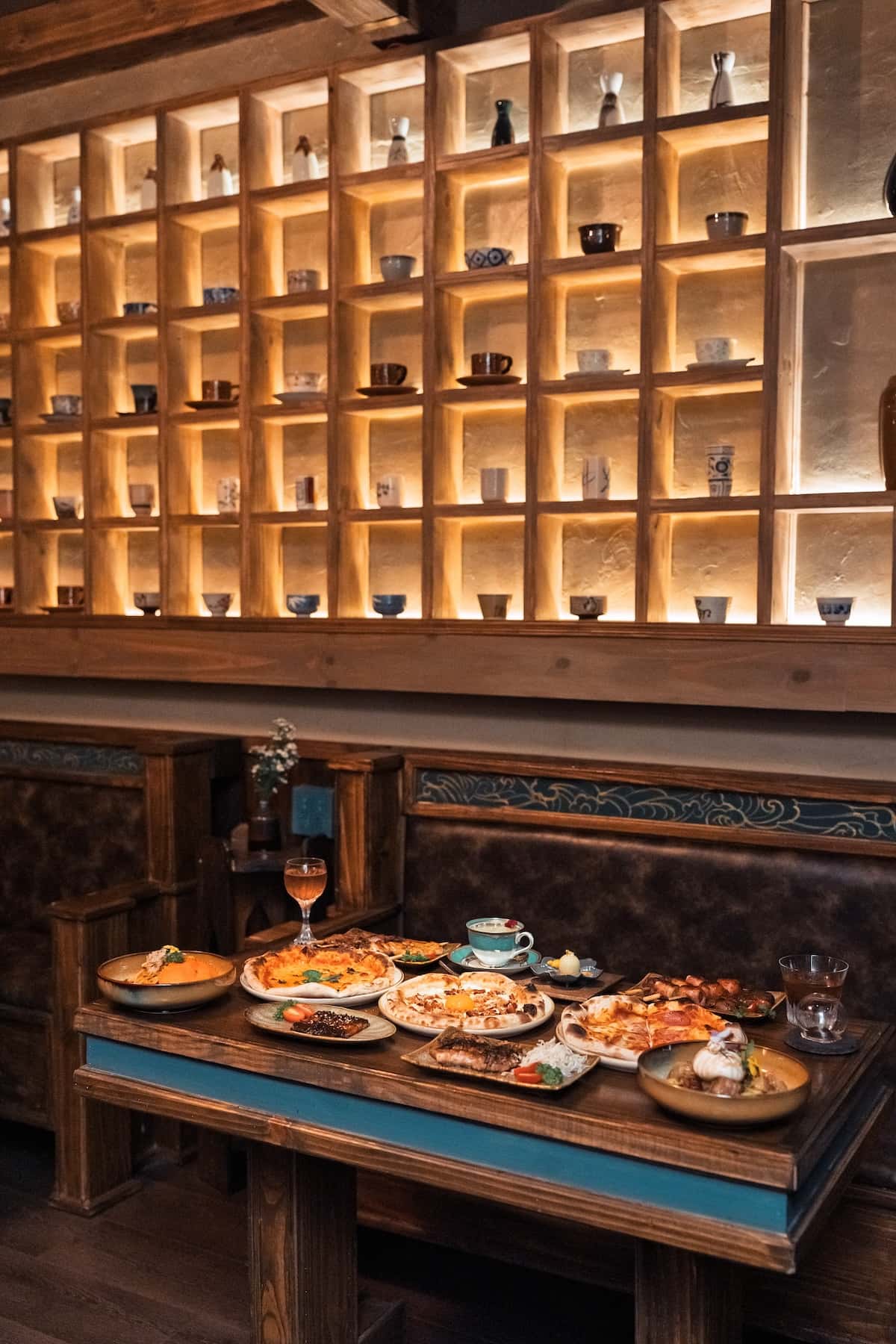
It keeps going into the bar itself where sake casks are stacked along the ceiling beams suspended by ropes. Along one side, a wall of backlit wooden cubbies holds sake cups and ceramics.
Two Van Gogh sunflowers – hand-painted homages to the troubled Dutch master – hang either side of an upright piano. And opposite there’s a triptych of Hokusai-style landscapes, hand painted too, that line one wall – Mount Fuji repeated across nine small panels, waves and pine trees and travelers dwarfed by all of it.
Set in the corner is the bar with its L-shape of seating along the expanse of a single long piece of tamarind wood as the counter – Vietnamese wood given Japanese polish.
The irori in the middle of the room flickers with stage lighting beneath logs of wood, feeling warm all the same while Khoi takes in Hiromi Go’s ‘Careless Whisper,’ the sax line stretching across the track, a song about heartbreak that still sounds like it’s smiling. “That’s what it does,” he nods, sagely, about the track and Japanese city pop in general with its sun-drenched instrumentation, driving basslines and warm synths paired with lyrics about loss and longing, and relationships already gone awry. “Good times and sad times. In the same song.”
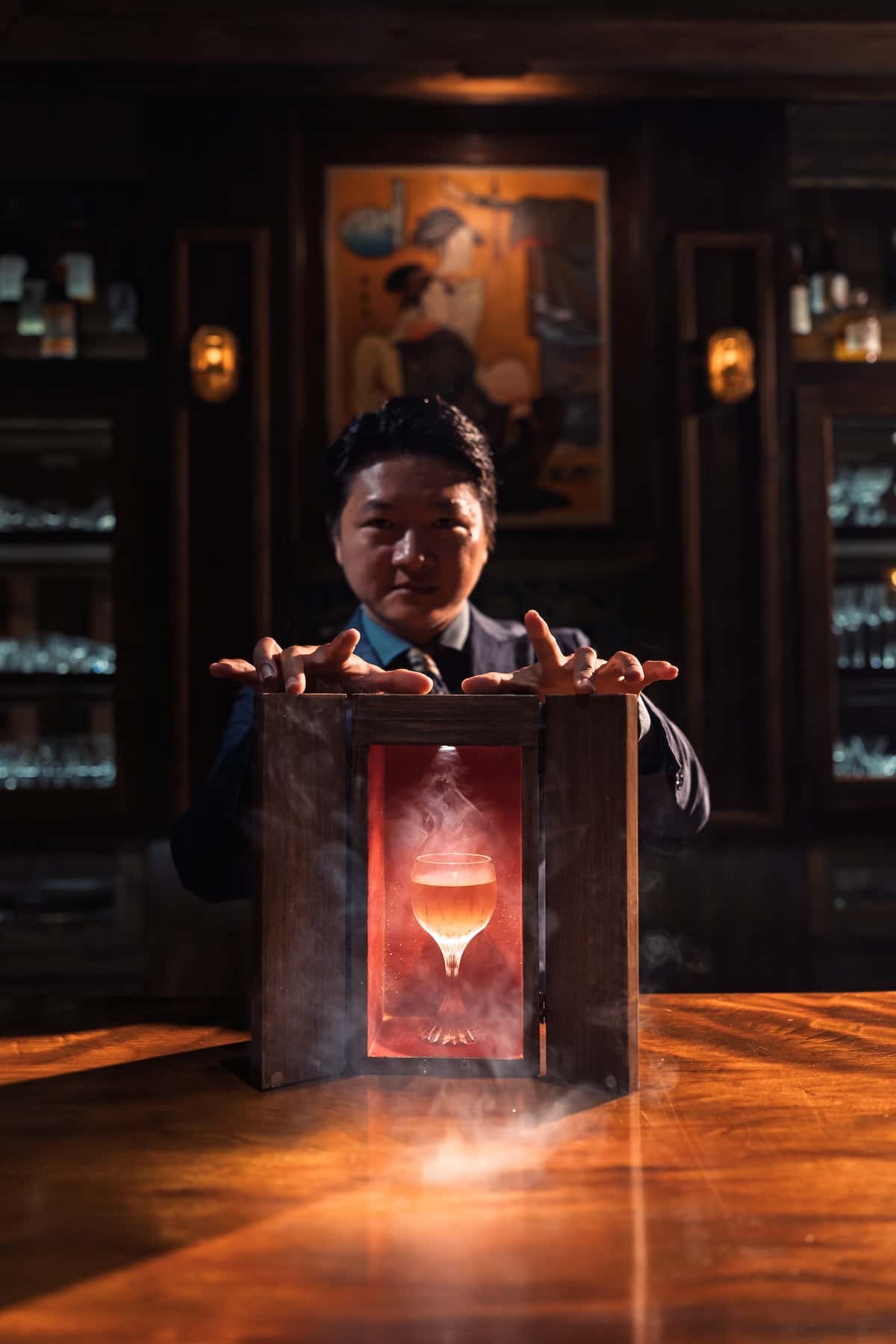
Signatures And Twists On Classics
Beside him Nhut takes a tumbler from the cabinet of imported Japanese glassware and busies himself making their Irori Manhattan, from the Twists on Classics menu.
Nhut explains it as he stirs: “Wild Turkey 8 Year Old instead of rye gives it more caramel and black pepper than a classic Manhattan. Herbs Mirin rice-wine sweetness leans the bourbon’s oak toward something closer to umami. There’s Dolin de Chambéry Rouge that keeps it light rather than syrupy. And chocolate bitters reflect the cocoa in the bourbon rather than adding it.”
There’s no delicate stem or coupe – just a heavy cut-crystal tumbler with faceted sides into which a ball of clear ice has already settled. Nhut finishes it with a cherry, speared on a long pin, lowered rather than dropped into the glass.
In the same menu, Penny Cola has the same bourbon poured over cola syrup, lime and ginger, with a float of Laphroaig 10 on top – a whiskey highball with a peated Scotch cap.
Its non-alcohol twin subs lapsang souchong for both spirits, using the tea’s own smoke to replace the peat. Honey King pairs chamomile rum and Campari and adds a dash of Tabasco – heat where a Negroni twist would remain resolutely bitter. And there’s the Salted Egg Irish Coffee – with Jameson, coffee, sugar and a salted egg foam.
The Magnetism And The Music
The food that comes with them features skewers close to izakaya orthodoxy – chicken hearts, liver, gizzard and king oyster mushrooms, charred hard over direct heat, the kind of low-stakes bar snack that separates great izakayas from average ones. The fish cake with mentaiko sauce carries the same shokunin technique with no Western detour required.
The pizzas take the Japanese-Italian detour all the same (it’s a city in thrall to it after all) with Vietnamese crab and salmon roe and a kanimiso sauce. There’s stewed beef tongue, in red wine and black miso. And the pasta repeats the beef tongue feat over noodles, alongside crab pasta and Hokkaido scallop with pesto. Then there’s a katsu sando with truffle sauce. And bruschetta three ways – shrimp with Vietnamese pesto, salmon with cream cheese and prosciutto.
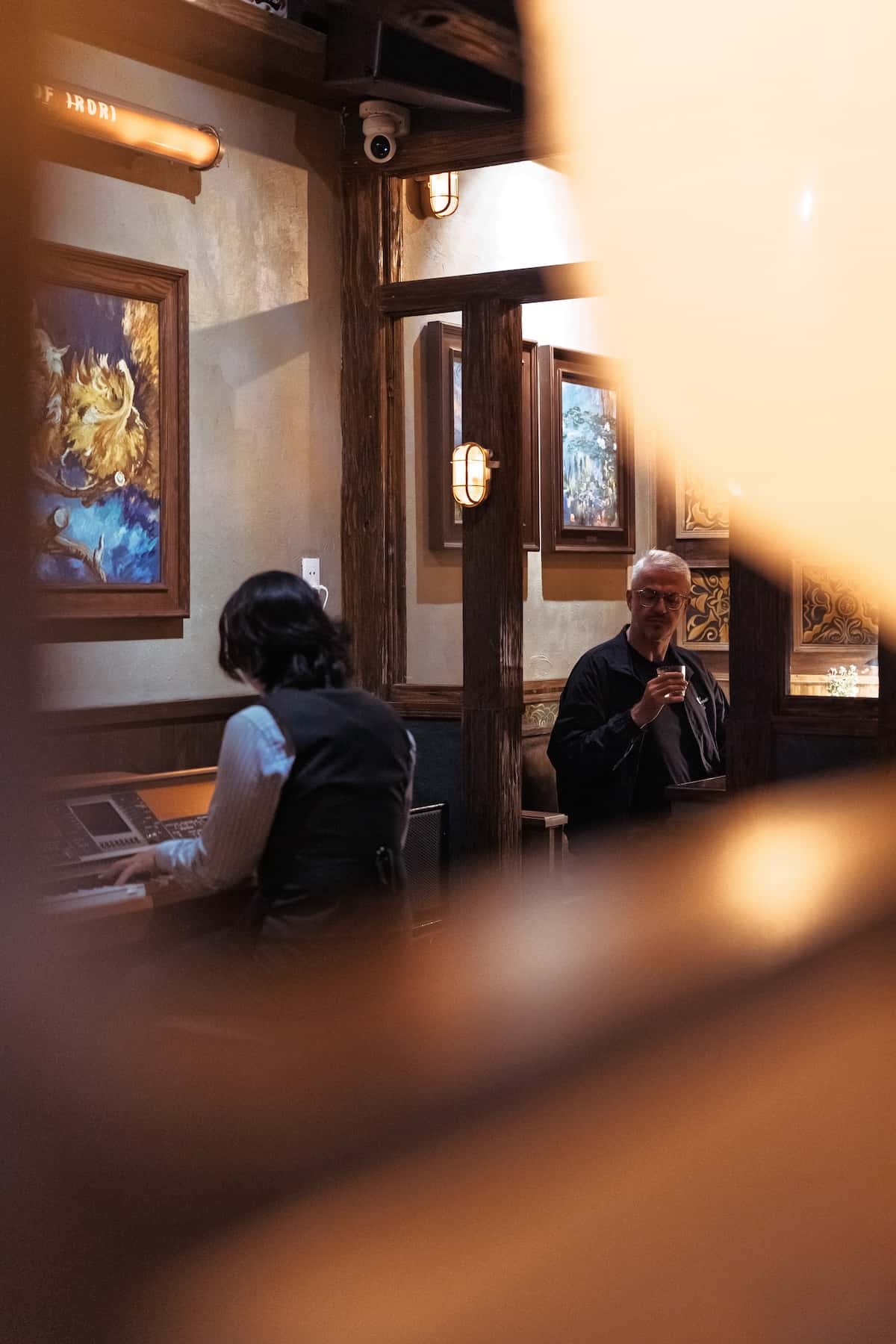
By the time the last guest has drifted off, Khoi takes his place at the piano at the far end, beneath the Van Goghs, and starts playing – stumbling into the first few notes like he’s finding them rather than reciting them, incredible once he does. Anh Thu, his colleague, starts to sing, and Nhut and the rest of the team gather round the irori. “Magnetic,” Khoi says, of the music. But he could mean the irori too – the regulars who’re left drift toward it without deciding to, whisky still in hand, still talking, as the music drifts between happy and sad.