



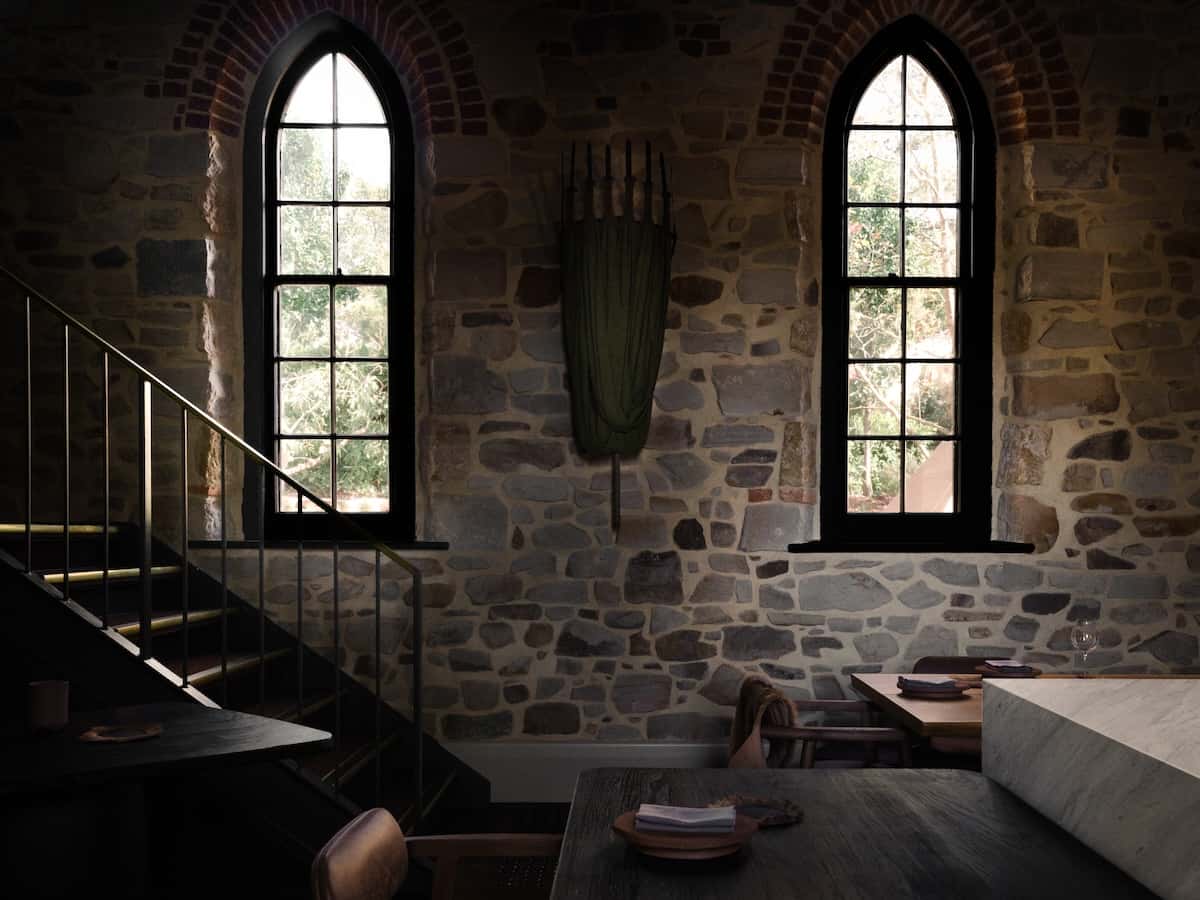
The moment you walk into Restaurant Aptos, in what used to be the Ashton Memorial Church, built in Stirling in the Adelaide Hills in 1868, you’re engulfed in darkness. Led Zeppelin’s ‘When the Levee Breaks’ is echoing from the void, a song about the 1927 Mississippi flood. Crying won’t help and praying won’t do any good, it warns.
There’s no use resisting Restaurant Aptos either.
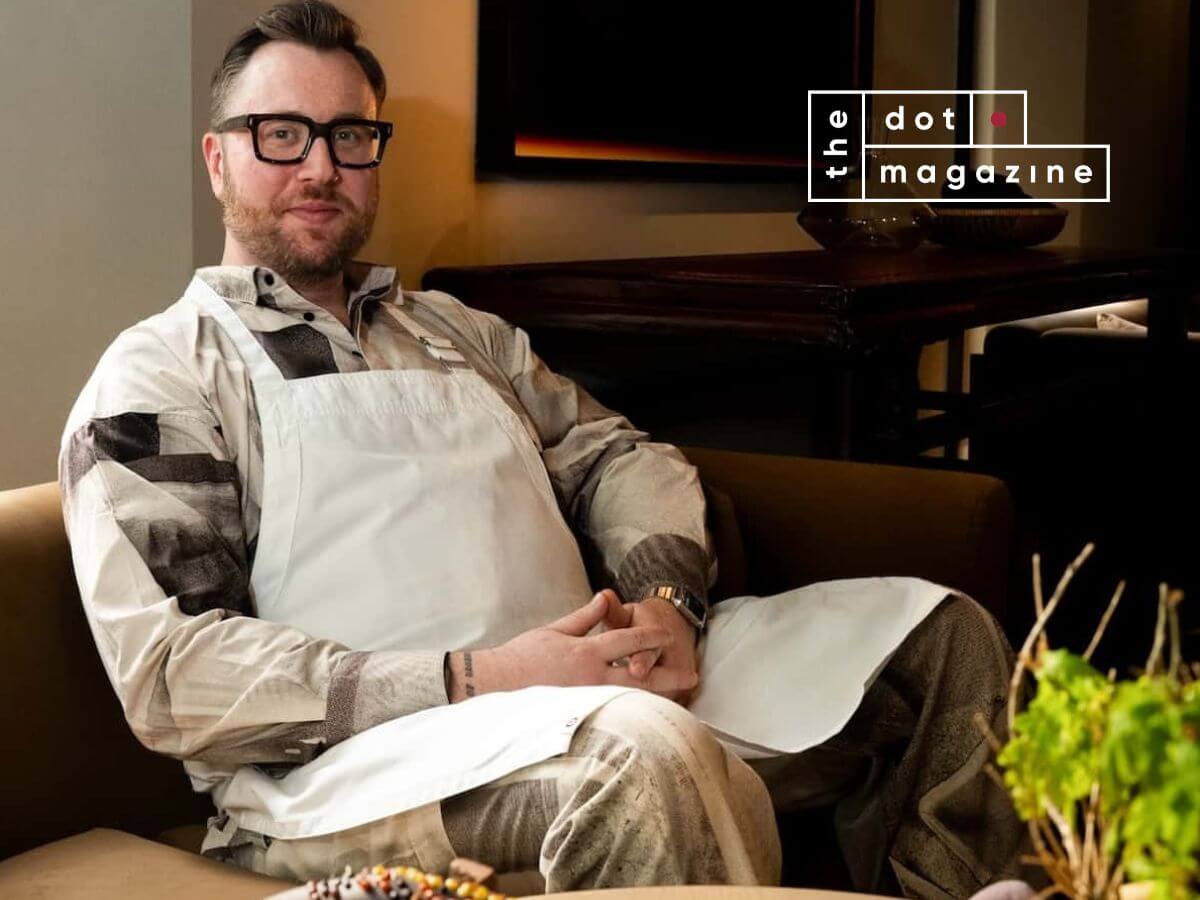
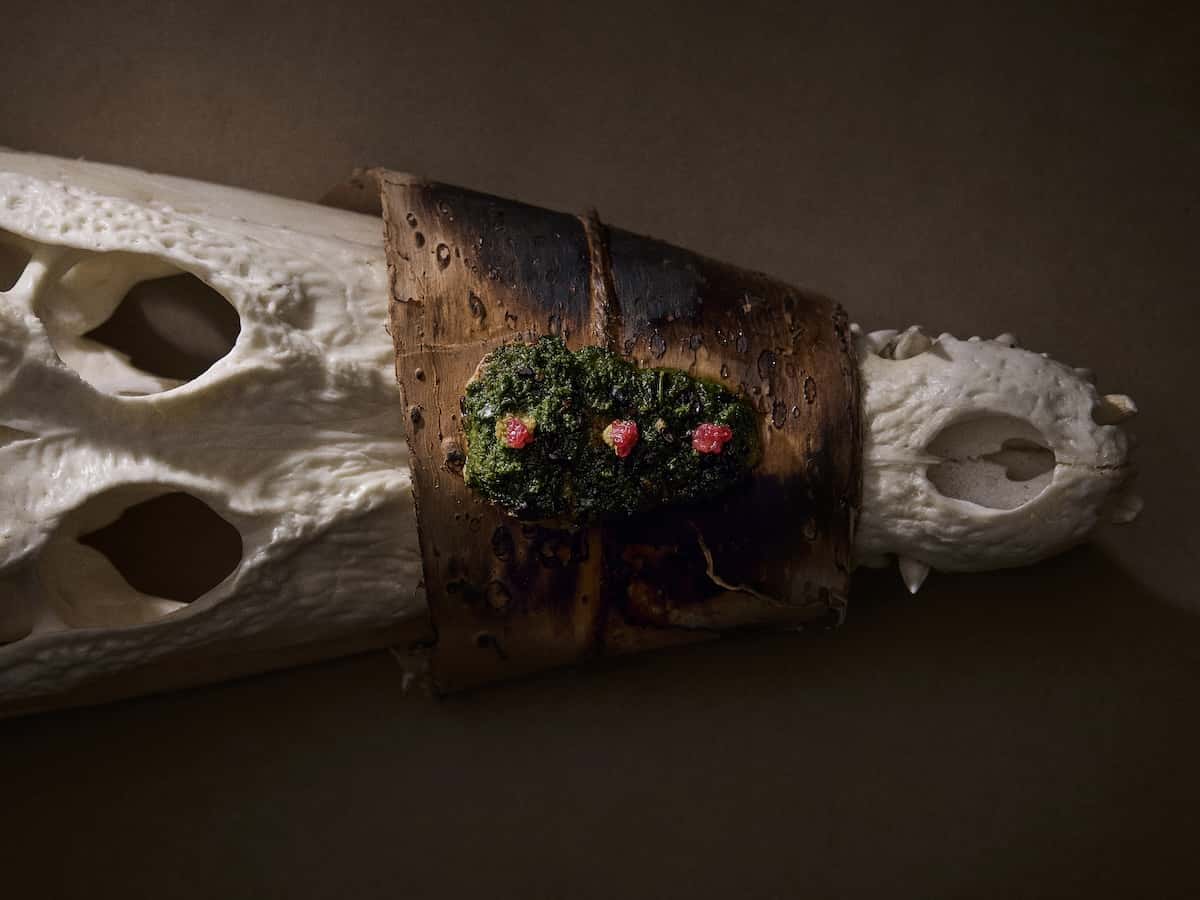
“Maybe the crocodile tongue on a skull is too much for you,” Chef Justin James says about one of his signature dishes. “But that’s what you’re here for. We want to challenge you. But we’ll also bend our ways to try to please you.”
It Cleanses You
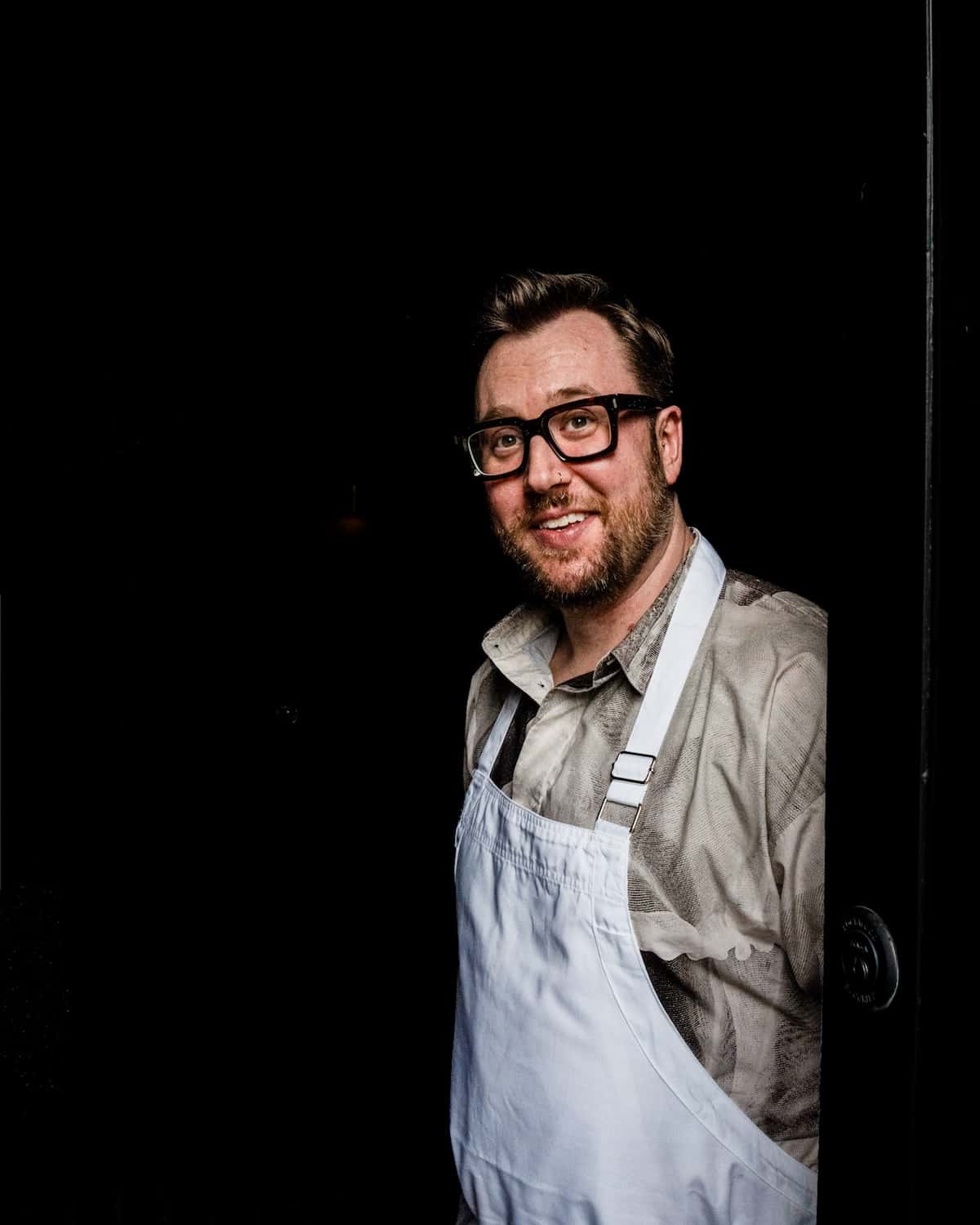
He had landed in Australia in 2014, two or three days before his 28th birthday. Before that he had spent four years at Eleven Madison Park in New York. “I asked myself what’s the furthest place away. Australia. And I was going to work my way home,” he remembers.
The trip was meant to take three or four years. Instead he became executive chef at Vue de Monde in Melbourne. “I even left once,” he laughs about his own inevitable capitulation to Australia. He went to Copenhagen for a stint at Noma. And then came back to run the kitchen at Restaurant Botanic in Adelaide – and took it to three hats in under two years.
Through the heavy church doors, the room is sparse and the ceiling high. At Headley Grange, Led Zeppelin hung microphones three floors above John Bonham’s drums and let the stairwell do the work. Justin does the same sort of thing here. “It cleanses you as you come into the next space,” he says. Then the room opens up “to remind you that you really are in a church.”
The bathrooms play gospel – three two-hour loops of preachers preaching. “Sometimes it’s light,” Justin says about the sermons. “And sometimes it’s dark.”
More Than Words
Only, the building wasn’t always a church. For decades it was Aptos Cruz Galleries, a design gallery run by Steve and Pat Ronayne. “When I told people about the church, they were like, ‘Ah, the Aptos Cruz Gallery,’” Justin says. “So, I thought that’s the name – Aptos and Bar Cruz.”
The gallery left more than a name.
There are 35 artworks on the walls, Justin reckons. The Lounge – which you enter first – has seats so low and languorous you’re almost lying on the floor, and there are artworks scattered everywhere.
In Bar Cruz and again in Bar Mary hang portraits of world leaders and military men by Melbourne artist Tony Garifalakis. Their faces are blacked out with enamel spray paint. What’s left is the uniform – the cap, the braid, the medals.
And in The Lounge there’s a holy figure with arms open in welcome and darkness where the heart should be, and Kate Mitchell’s neon text piece, ‘A Light Sentence.’ Which reveals another of Justin’s preoccupations – playing around with words. The menu is a run of puns. Kangaroo and wagyu become Wag-a-Roo. Prawn and bunya nut become Prawnya. Crocodile tongue served on its own skull is Crocodile Tears.
More Salt, More Acid
On the stairs up to The Parlor, a knitted panel studded with pearls reads ‘Quite Enough.’ “Because you’re pretty full by this point,” Justin elaborates. The Parlor has a bookshelf Lucas Grogan painted especially for the restaurant, its spines lettered with Justin’s sayings. “More Salt, More Acid” is there because nothing is ever seasoned enough.
So is “When in Doubt Felt It” – his aversion to noise compels him to put felt on the bottom of the trays and some of the plates. There are team in-jokes like “The Bay Leaf Conspiracy” and bugbears like “The Food for Free Influencer.” Its painted spice rack holds Mirth, PTSD and Payback – and just a hint of saffron.
The staff door has a ‘Legends Only’ sticker instead of ‘Staff Only.’ “Delivery drivers sometimes don’t think they’re allowed through, and every day there’s a new joke about it,” Justin says.
Dinner itself takes guests through three rooms. The first six courses, mostly chilled, are served in The Library, on couches draped with kangaroo fur. Then, pressing a copy of ‘Where Chefs Eat’ on the bookshelf opens a secret door down into The Kitchen. It’s dim and warm, lit mostly by candles – a little hygge brought back from Copenhagen.
There the centerpiece is a four-meter table cut from 450-year-old French oak. Another shared table is close enough to feel the heat of the grill. Then the tables at the back are kept for couples celebrating anniversaries, or anyone a bit more introverted.
Then finally, dessert is upstairs in The Parlor. Every room has its own playlist, and every floor its own napkin colors, chargers and glassware.
Restaurant Aptos Is Always Evolving
Bar Cruz just opened. It’s based on the same idea as Aptos – Australian ingredients – with a five-course menu and bar snacks. Its dining room seats 10. Tonight they’ll squeeze in 12. “It’s pretty vibey,” Justin admits. So is the teepee outside in the yard with its disco ball rotating slowly. Nights sometimes end there. Or upstairs at Bar Mary, the whisky bar. Or back in The Lounge.
The yard with the teepee got as much thought as the rooms. “I had two ways to run it – leave it how it was, a very organic place, or give it the same attention as inside,” Justin says. He went to a South Australian bluestone quarry, picked the stones out of the earth and watched them being chiseled out.
The garden feeds the menu. The gumnuts in course one come from out here, and so do the muntries, finger limes and lilly pilly berries. Geraldton wax grows here too – the citrusy, piney leaves the crocodile tongue is slow-cooked in. There are warrigal greens that taste a bit like spinach, and native lemongrass. The lemon myrtle and anise myrtle trees are still young. “But they’ll grow,” Justin says.
In summer, dinner might even start out here, near the pizza oven, the barbecue and a shared table beyond the teepee, “because maintaining means evolving.”
“We just served the entire tasting menu for a group in Bar Mary,” Justin says, raising his eyebrows at the memory of Aptos’ three kitchens converging to serve in the same space.
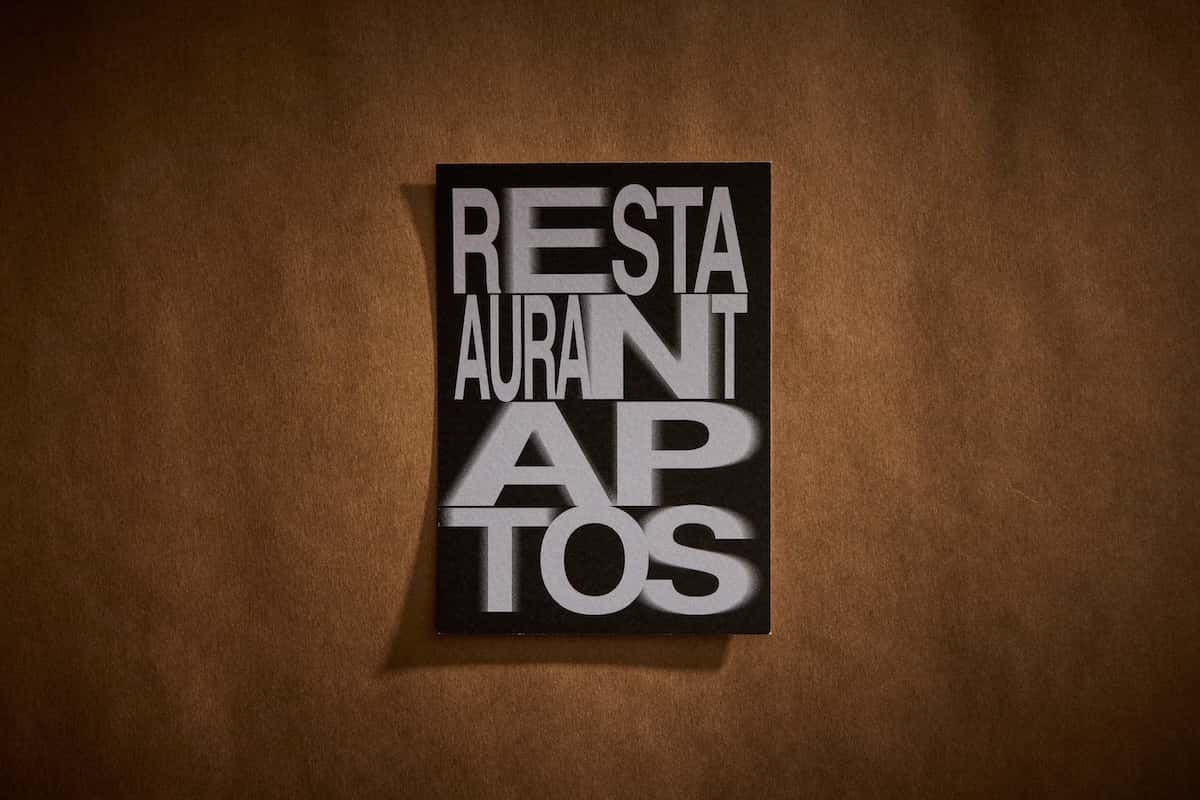
He likes to put himself and the team “in the shit” sometimes, he admits. For all the preparedness of the tasting menu – 16 courses, each with its own explainer card and a bold, mostly black-and-white graphic on the front – he’s still willing to change it on the day. “Sometimes I’ll have an idea, really we should wait, but let’s do it,” he says.
Just Doing It
Tonight, for example, a new course is going on the menu: razorfish. The Kitchen usually serves five courses. Tonight it serves six. Aptos gets 50 a week and is the only restaurant in the country serving them.
“The thing I’ve learned is you could sit here and think about things for months or weeks but you’re never further ahead than the person who just does it,” he says.
“Nike, just do it!” he laughs, revealing his American roots. Justin grew up on a farm about an hour outside Detroit, in Michigan. He studied civil engineering at Michigan State (his father’s idea) and cooked in a Chinese restaurant on the side. Then he went to culinary school in Vermont and moved on to Blue Hill and Eleven Madison Park.
He brought all of that to Aptos. But the dish he says sums the place up could only be served here. It’s the first, ‘Five Australian Fruits,’ and the first one he came up with for the restaurant. The native fruits – muntries, Illawarra plum, desert lime, quandong and sunrise lime – are turned into purées and dotted along a branch. “You pick it up and lick it,” he says. “And you just go, I’m not in for normal dining here.” Then you suck the gumnut and peel a leather of muntries, desert lime and grilled strawberry off a lemon myrtle leaf. And you’re still only on course one.
Going Native
The branch is a bold statement of intent. Every dot on it is acidic, sour or salty. Justin built it that way. “You start with something quite sour, and finish with the quandong that’s quite salty,” he says. It’s not only the flavors – the stark hit of acid like a slap around the face that greets you – but the tactile nature of it all. Picking up. Licking. Peeling.
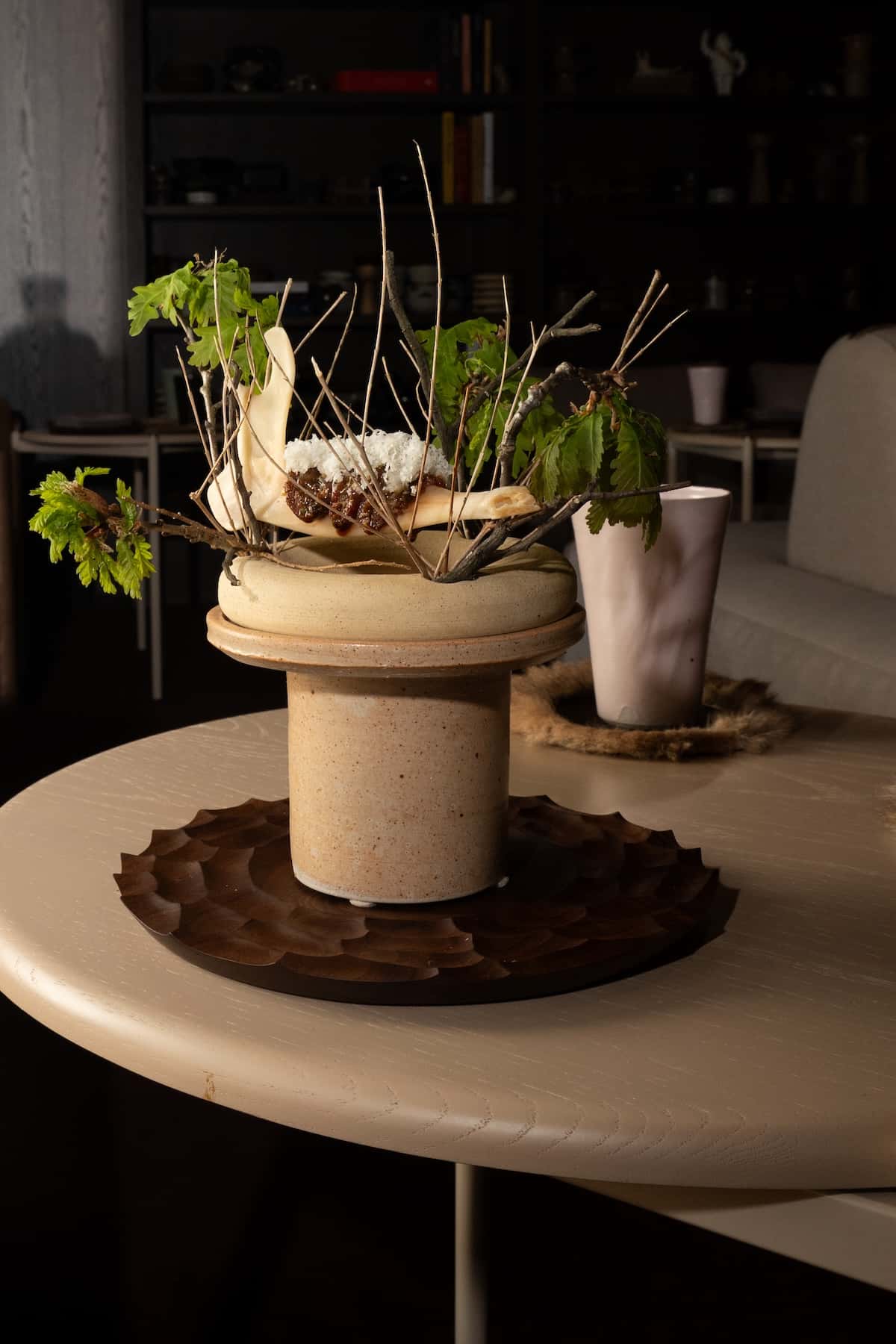
There’s the occasional spoon reluctantly offered with courses, but it’s mostly hands-on like that. The venison, for example, comes draped across its jawbone, a snowfall of shaved macadamia on top, and hidden among branches. You lift the jaw bone free and eat straight off it.
You eat the abalone – marinated in miso, kissed over charcoal and glazed with grilled desert lime – off a stick, piece by piece.
The prawn comes skewered on a bunya branch, and you finish by slurping the sauce. The marron tail, which you dip in a warm lemon myrtle béarnaise, is skewered on its own claws. The frozen dessert is an ice lolly on a stick. And the waffle, served after it, comes stuck to a strip of paperbark. “It’s literally just two ingredients,” Justin says – flour and cream. The cream is smoked with paperbark and the flour is mixed with ground wattleseed. It all goes into the waffle iron pressed against the bark, then gets brûléed and brushed with a whiskey glaze of honey, brown butter, lemon zest and three or four green ants. You bite down to the bark and slide the waffle off.
Course After Course
“I can do beautiful,” Justin had reminded us earlier. “Canelés with perfect ridges and stuff. I’d just rather do this.” So the food comes on bark, sticks and bones. But it never looks rough. A mandarin is coated in beeswax and hollowed into a bowl for bluefin tuna and sea urchin. A scallop sits in its half shell over crushed ice in a bowl made of ice. Even the smallest kangaroo meatball comes wrapped in a rosella flower.
None of it is treated as exotic. The menu has 40 to 45 native ingredients, including three plums and three myrtles. Kangaroo, emu, wallaby and water buffalo all appear. Green ants turn up in seven or eight dishes, “but you might not know it,” Justin says. His idea of luxury runs the same way. “To me luxury is green ants,” he says. “I’d prefer bunya nut over cashews.”
Rarely, like Tony Garifalakis’ blacked-out faces, Justin is opaque about the ingredients in his dishes. Course five is a small bowl of jelly beside a piece of smoked water buffalo. The menu card asks: “What was the jelly?” The answer, it turns out, is possum. Justin roasted some and found it sweet – “like berry, vanilla.” It turns up once. But most of what he uses comes back course after course.
“A lot of restaurants that might focus on some of these ingredients, they might just use it once,” he says. “I think it tells a better story of Australia.” Sometimes that story is light and sometimes it’s dark. Either way, there’s no use resisting.