



The gin is Vietnamese. The botanicals are Vietnamese. Even the name is Vietnamese – Baigur is the name for the settlement that became Saigon back when it was a humble fishing village and spice trading outpost. Dutch founder Jochem Lisser and master distiller Phu have spent years combing the markets, highlands and river deltas of Vietnam for ingredients worth putting in their unmistakable bottle now sold in 50 countries. The Saigon Baigur distillery in District 9 where it’s all made is as playful as the product. There, visitors can pick their own botanicals, run their own miniature still and leave with something entirely their own.
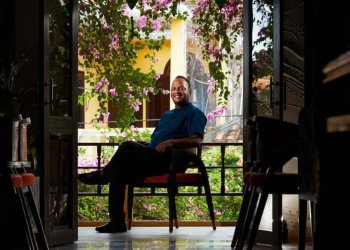
“It’s probably because most people have never seen a dragon egg,” Saigon Baigur’s founder Jochem Lisser says, with the mild impatience of someone who has made this correction many times before. He’s comfortable on the plush new sofas at Saigon Baigur’s distillery and experience space, and he’s become comfortable with the confusion too.
The bottle – the one now sold in 50 countries and counting – is not based on a durian. Not a pineapple. Not a hand grenade, though that comparison comes up more than you’d expect. “It’s based on a dragon egg,” he asserts, perhaps hoping to put an end to it once and for all.

From The Soil Of Vietnam
In Vietnamese tradition, the dragon lives in the sky and controls the weather – farmers pray to it for good harvests. “We use local ingredients, all Vietnamese, from the soil of Vietnam,” Jochem says. “So that’s why we chose the dragon.”
The debate should be seen as a compliment, really. The bottle is a conversation starter – dark smoked glass, squat and oval, covered in raised diamond facets that catch the light like reptile scales. A flat base narrows to a short neck, finished with a copper cap and a copper diamond label at the centre. Dense and tactile for a gin bottle – in a category full of bottles that look like they belong in a Duty Free, this one looks like it belongs nowhere else on earth.
Few spirit bottles could inspire such a discussion.

The bottle, Jochem explains, was chosen before they fully understood what they were getting themselves into. “We didn’t know anything about the practicalities of it. It looked nice. So we made it.”
The complications came later – you can’t stick a paper label on curved faceted glass. So they switched to metal. But he has no regrets. “In this business, how your product looks is very important. That’s the first impression. They don’t know your gin. They’re looking at a long row of products. You can have a good gin and still need a good bottle.”
That’s especially true given the breadth of places where the gin is now sold. Some of them still catch Jochem and Phu off guard. A friend spotted it in a store in Uganda. It sells in Peru. It sells in Barbados. And apparently somewhere else in the Caribbean that neither of them could immediately place on a map. “It ends up in places we never imagined,” Jochem says contentedly.

Proving To The World Vietnam Can Make World-Class Spirits
But the inspiration for the bottle isn’t the only misconception Jochem and master distiller Phu have been working to dispel. The name Baigur is the old name for Saigon, when the southern metropolis was merely a sleepy fishing village and spice trading outpost. From there, the search for botanicals took them to the furthest corners of Vietnam, from the Mekong Delta to the far north, fueled by the ambition to prove to the world that Vietnam can produce world-class spirits.
“There’s black cardamom from the far north. Buddha’s Hand citrus from Hanoi. Cinnamon from the Annamite Mountains ranges of the Central Highlands. Lotus flower from the Mekong Delta,” Phu explains. “And our juniper comes from Macedonia,” he adds about the one component, essential to any gin, they have to source from outside Vietnam.

Phu is happy to offer an overview though: “Vietnam is a land of herbs and spices. Produce that is essential to our cuisine and culture. That is what we wanted to share through our gin. It’s like traveling Vietnam by your mouth,” he says. “You drink the gin and you feel everything. Every place. Every spice.”
It took two years of experimentation to settle on the final mix of botanicals and juniper. Jochem genuinely considers it his favorite gin. But when pushed, he admits: “I might make an ultra-spiced version one day, with a higher dose of the spices and more fresh Buddha’s Hand citrus.”
“I like the citrus notes and floral fragrance – so I’d like, one day, to play around with different types of fruit in the citrus family and flowers from Vietnam to create a very fragranced gin.”

Embracing Playfulness At Saigon Baigur’s District 9 Distilling Company
That playfulness is fully embraced at the District 9 Distilling Company. This is their second location on the same street – a more cavernous base for the brand. They’d long outgrown their previous address, where pallets of boxes left hardly any room to walk around. “After searching for six months all around the city, we ended up renting this beautiful place 500 meters down the road from the old one,” Phu laughs.

The road to District 9 Distillery shows Saigon’s working-city side. Overhead cables knot in the sky like spaghetti, dust-caked dump trucks squeeze past scooters and street vendors sell fruit and vegetables from carts parked against giant concrete drainage pipes waiting to be laid. Hand-painted signs advertise silver jewellery and fish. And a woman sells green pomelos from a trolley in the shade of an orange parasol.
Then you turn off Vo Van Hat Street, where the building is marked by a large cut-out image of the Saigon Baigur bottle. The gates open onto a garden – palm trees, tropical plants, a small pond with a fountain, and a silver dragon sculpture coiling around the base of an old longan tree. After 40-minutes of city sprawl and increasing urban grit, it’s peace at last.
Through the garden, past a small bungalow on the right and the bar on the left, the distillery opens up around you. The lounge is ringed with stills. The two smaller ones beside a window looking back out over the garden are called Fire Dragon and Metal Dragon. Beyond them stands the centerpiece called the Mother Dragon, that has the quiet authority of something that does the hard work around here.
At the far end, the workshop room has eight miniature copper stills lined up along a counter, and behind it a traditional medicine cabinet filled with jars of spices sourced from across Vietnam. It looks like an apothecary dreamed up by someone who really loves gin – which is, more or less, exactly what it is.

Gin-Making Workshops In Saigon
Visitors get to make their own gin on one of those miniature stills, choosing their botanicals and leaving a few hours later with a bespoke bottle to show for it.
They can start with the stabilizers on – Phu’s suggested recipe, printed on a card. There’s juniper at 20 grams, coriander at 10, angelica root at 5, and then nutmeg, green cardamom, orange peel, fennel seeds, cinnamon and rose in descending amounts. “It is very easy to make mistakes with botanicals. For a lot of spices, even in small amounts they become completely overpowering. You put a little too much of let’s say cinnamon and it is all you will taste,” Phu explains.

With that in mind, he’s fine if you disregard the advice. The ingredient menu runs across four categories – gin base, citrus, floral and herbal, and spices – with the Vietnamese name alongside the English and a brief flavor note for each. Dry lime is zesty, tangy and sharp. Clove is warm, pungent and dominant. Dried chili is hot and smoky. Your still runs, the distillate comes through, and a few hours later you leave with a bottle of something that is a reflection of your own instincts.
A minivan runs back to Thao Dien so nobody has to worry about cracking open their own bottle on the premises to let their botanical choices speak for themselves or about having one too many of the cocktails served at the bar up front: a Saigon Baigur and Tonic (in both dry and rainy season iterations), the exotic fruit-filled Summer In Saigon, or the BMT (which stands for Bun Ma Thuot) Breakfast, inspired by ca phe sua and that coffee capital of the highlands.

Conversations At The District 9 Distilling Company Dragon Bar
It’s a great place to strike up a conversation with Jochem, Phu, or any of the team – particularly after the daily distillery work is done.
And right now, the conversation just turned to gin history. Asked which famous figure from the gin world he’d most like to invite to the distillery, Jochem doesn’t hesitate. “Churchill,” he says. “The most famous gin drinker – famous for the quote about his preference for Dry Martinis that goes, “I would like to observe the vermouth from across the room while I drink my martini.” Phu has a different answer: he wants to meet whoever made the original genever, the Dutch precursor to gin.

Just then you notice that above the bar is a dragon head watching over all of it – a large bronze sculptural piece, fierce-faced, set against deep green scale-pattern tiles, with Saigon Baigur bottles stacked beneath it, their diamond scales catching the light. Jochem glances up at it. “See,” he says, frowning again. “I told you the bottle is a dragon’s egg!”