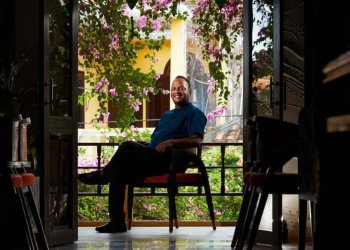



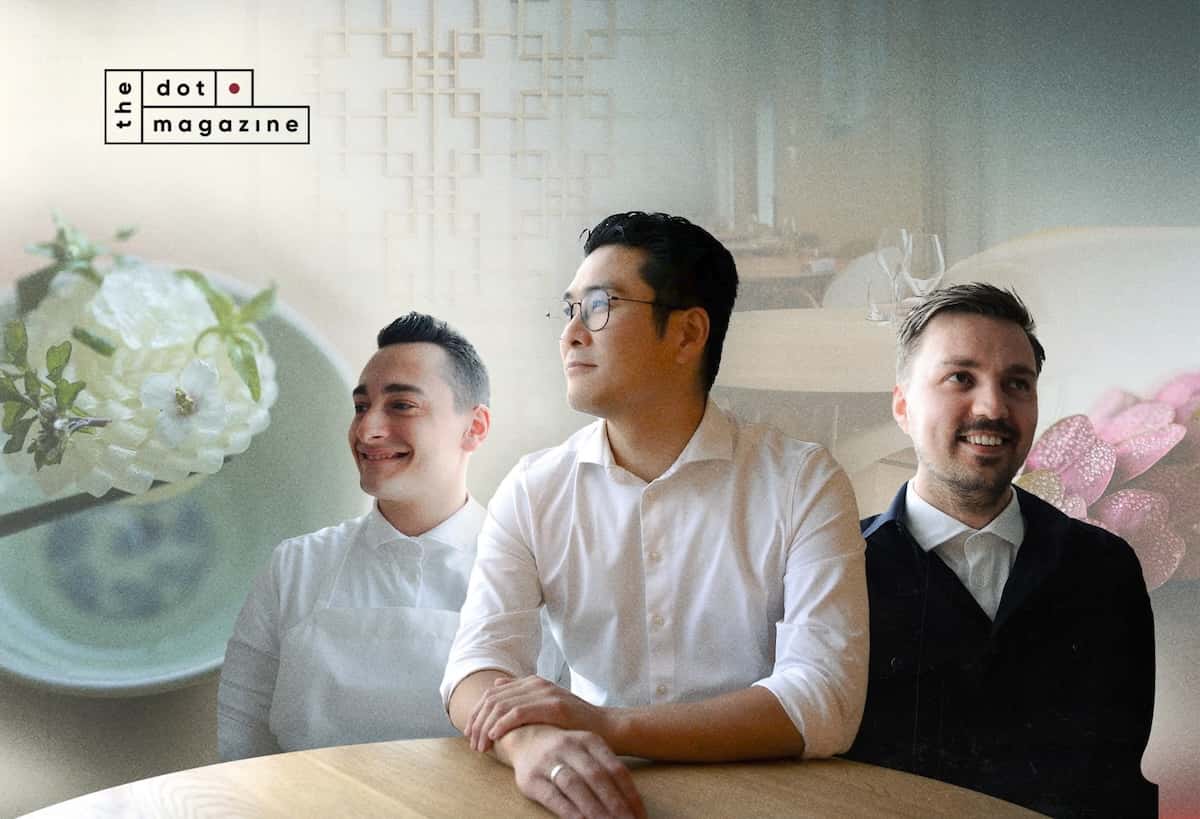
Kristian Baumann was born in South Korea and raised in Copenhagen. He has spent fifteen years trying to understand what that means on a plate. At 108, his first Michelin-starred restaurant, he got close. Then he closed it, in the middle of a pandemic, and started again at Koan, his endless inquiry and his ode to incompleteness.
At Kristian Baumann’s Koan, there’s a dawning sense that every element of the experience has been considered. “I do think about every little detail,” Kristian widens his eyes. He’s an entirely more unassuming figure than the one quietly, conscientiously directing the previous night’s dinner service with a gesture here and raised eyebrows there — signalling a dropped napkin, or a dish ready to set on the table, an adjustment to pace, or a top-up of wine for the thirsty guest at table four.
Koan Copenhagen Wants You To Be Hungry
That’s true right from the moment of booking. The website aesthetic is dark and dramatic. A red ensō circle — a Zen brushstroke not quite closed, suggesting incompleteness — sits at the top centre, there are two MICHELIN stars, the restaurant name and a booking button. And that’s it.
“There’s no pictures. It leaves you hungry,” Kristian smiles mischievously.
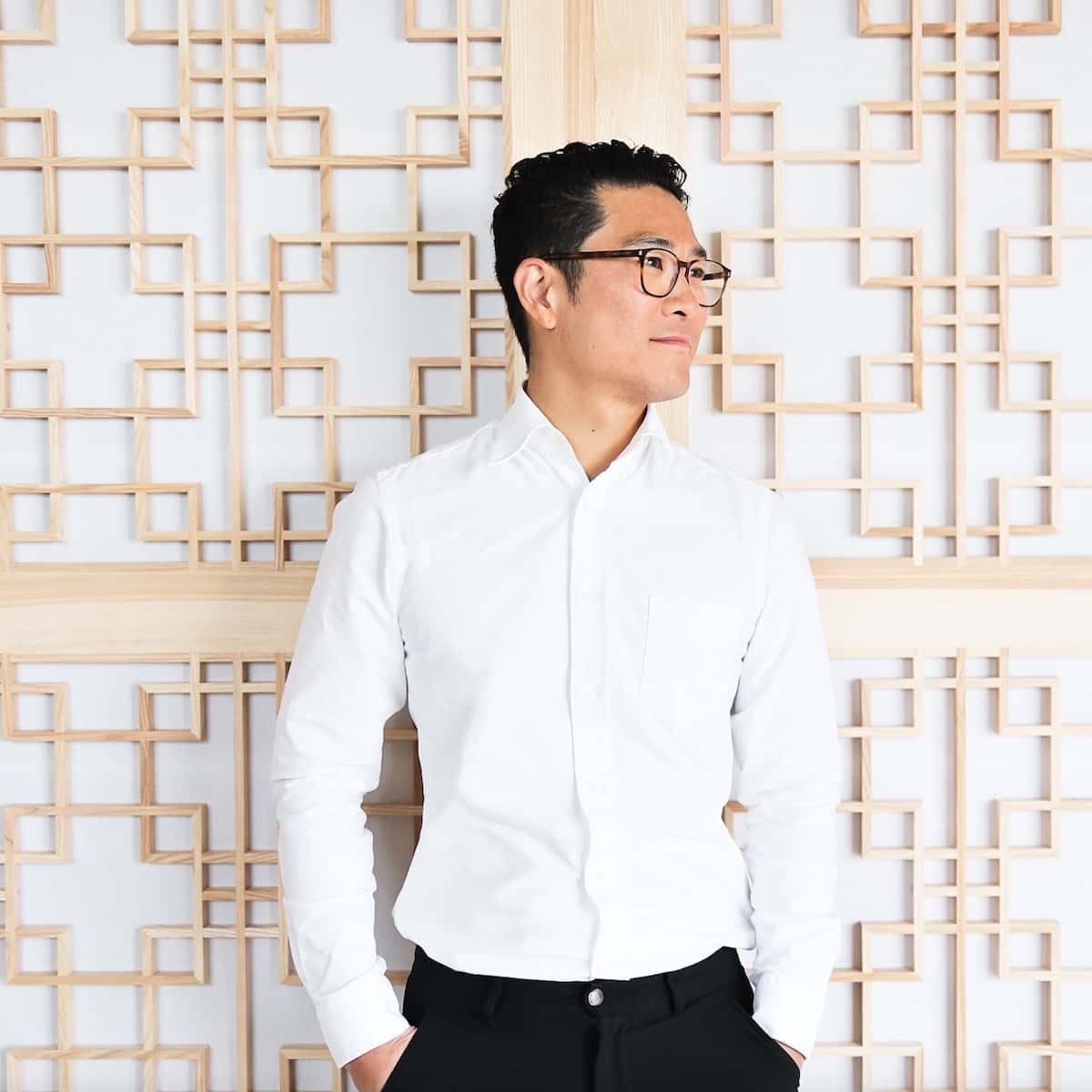
The Mystery Continues At Kristian Baumann’s Koan Copenhagen
Then you arrive — perhaps dropped off by a confused Uber driver, or on foot through the park, past the Little Mermaid. “And you see this old building which used to be storage space, and the mystery continues.” You’re on a pier. The water is close. The city is close, but somehow it doesn’t feel like it. Two members of staff greet you outside. They take your coat. Then the door opens to reveal a dining room with high ceilings (“which we fell in love with”) and an oddly shaped space that tapers at the far end.
The closest table is one metre from the pass. And that serves different purposes. There’s an intimacy that it creates, a constant widescreen show of movement from the team to animate the experience, and the food arrives moments after it’s plated. “And I like that way of running service,” he nods, “and, I think, it adds lots for the guest also.”
From where Kristian stands, he can see every table. And every table can see him. “You have to communicate with your eyes. Everyone is trained to look at your colleagues at all times.”
The Reveal
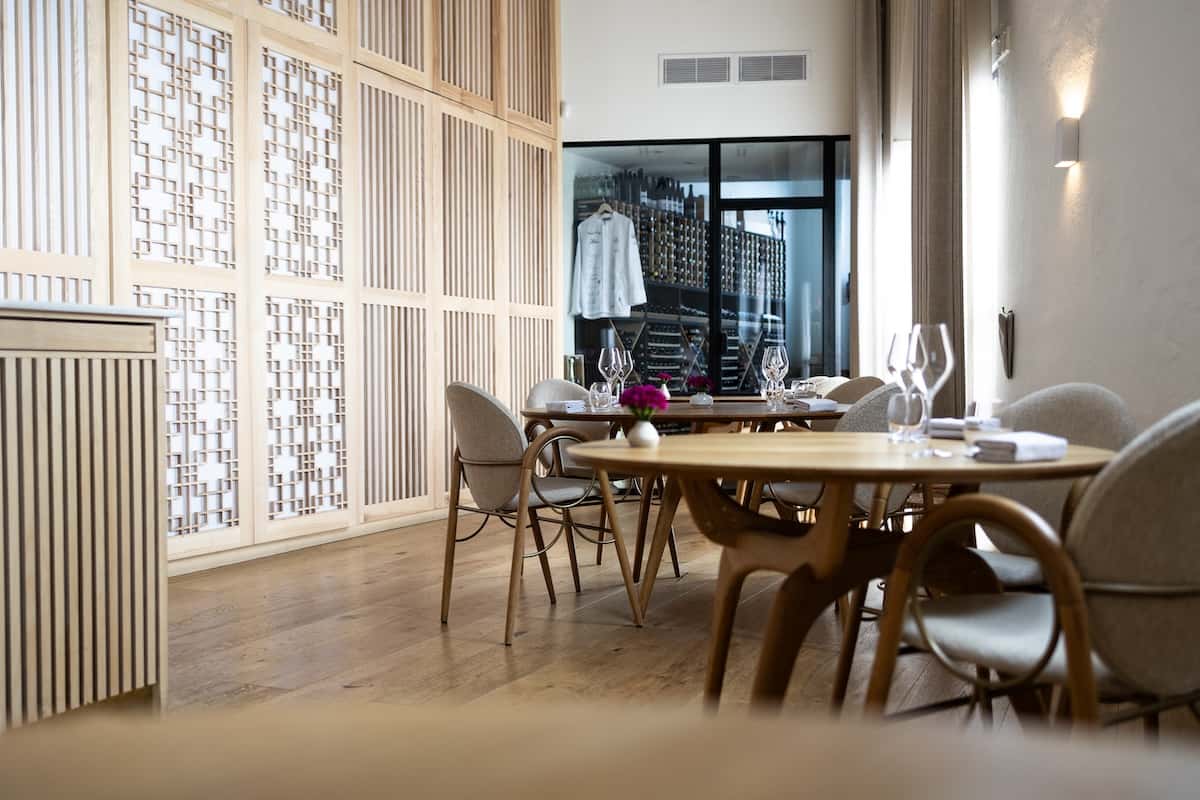
Besides that, it’s a minimal space — geometric patterned panels, light wood and soft lights with the Copenhagen spring still intruding through the windows. The wine glasses are hidden in a cabinet until the moment they’re needed, “which is nice when it’s revealed.” The cutlery lives in drawers. Round tables seat guests side by side, not opposite. “It’s intimate somehow. Not threatening,” as Kristian explains it.
The experience of sitting down is calculatedly casual too. There are no monologues about the concept, no descriptions of the provenance of the ingredients. “In some restaurants I’ve been overloaded by it. It can be too much,” Kristian asserts. At Koan, food explanations are straightforward. “And then if you want to know more about a dish, or the plates, or anything else, we’re more than happy to talk.”
18 courses, three sections. Some dishes have been on the menu since opening in April 2023.
In September 2020, Kristian closed 108 — his previous Michelin-starred restaurant — and within weeks announced something new, even though the timing was not ideal. “In the middle of COVID, when everything was a little bit up in the air,” he says, understating the turmoil of the time somewhat.
The first iteration launched in October 2020 at the Empirical Spirits distillery on Refshaleøen — eleven courses served across the water from where Koan now stands. When lockdown hit, he pivoted to takeaway. Then in 2021 it moved to Jægersborggade, into the former space of Relæ, where he’d worked with Chef Christian Puglisi and Jonathan Tam at the vanguard of sustainable fine dining, and stayed for roughly a year. “We always knew we were going to find our permanent location. We just wanted to make sure we made the right decisions,” he remembers.
By April 2023 he discovered this heritage harbour warehouse at Langeliniekaj 5, near the Little Mermaid, on the pier. Ten weeks later, Koan received two MICHELIN stars.
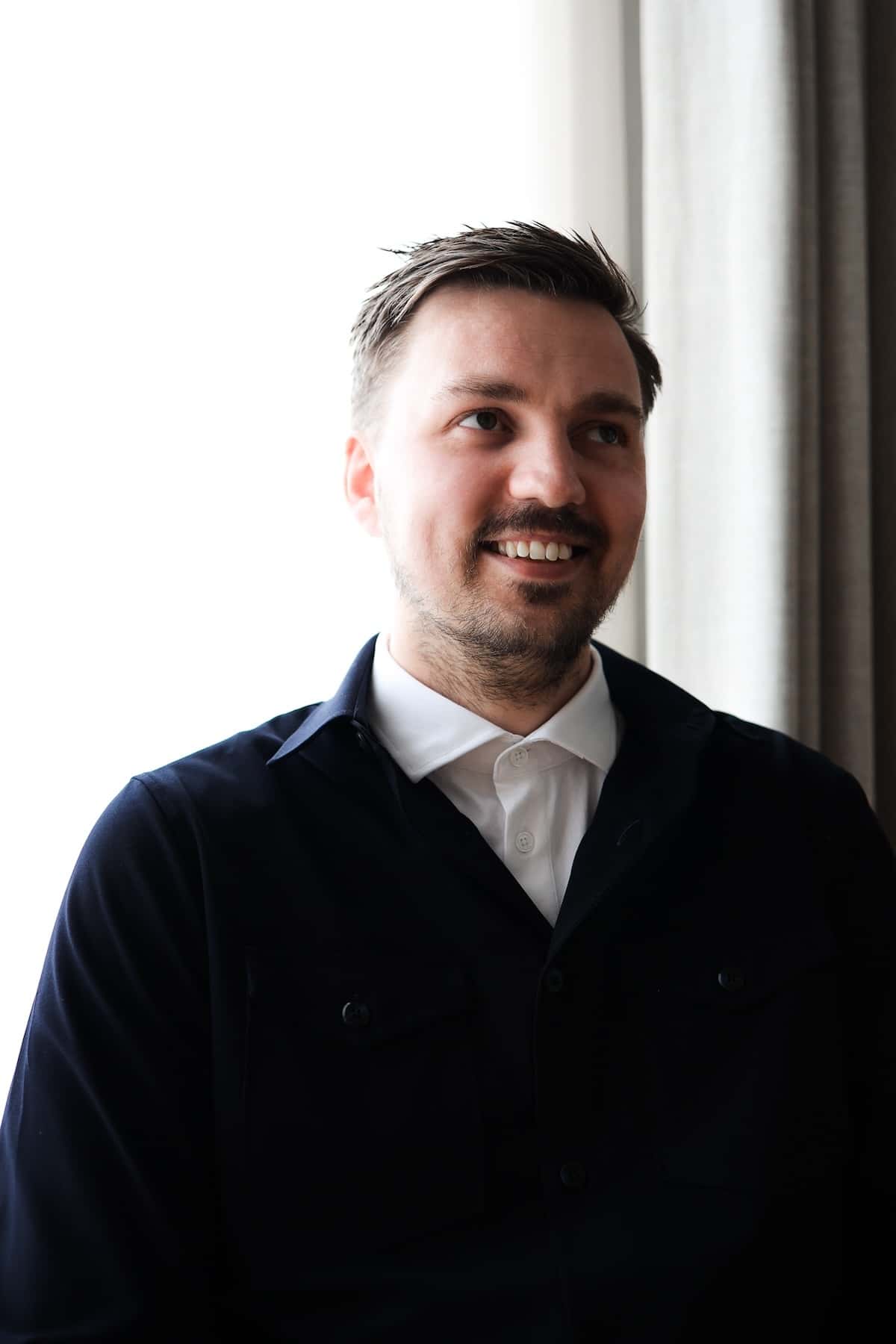
“I guess I was venturing out on a journey that I’ve been on since 2011,” he reckons. The warehouse was new, but the journey — back to South Korea, to memory, to the food culture Kristian has spent over a decade trying to understand — was already well underway.
Disappear And Return Again
That journey is visible on the plate. While the menu has a through-narrative — temperatures, ingredients, the logic of how one thing follows another — it isn’t fixed. Others evolve, and some disappear, only to return again. The mandu — a take on the Korean dumpling, a holiday staple that Kristian, adopted and raised in Copenhagen, never got to fold with family — has taken various shapes over the years. Right now it’s back: a translucent wrapper over fjord shrimp and cured pork fat, sitting in a gochugaru and mussel sauce, topped with pickled rose petals that give it a lavender flush. “It’s quite a powerful start, which is what we wanted.”
The langoustine and beef works the same way. The combination, he remembers, traces back to a pop-up in 2021 — grilled langoustine with aged dairy cow, same supplier. It worked. So the work continued. “You can take a note or an idea that you’ve had for a long time, and then figure out how to make it something new.”
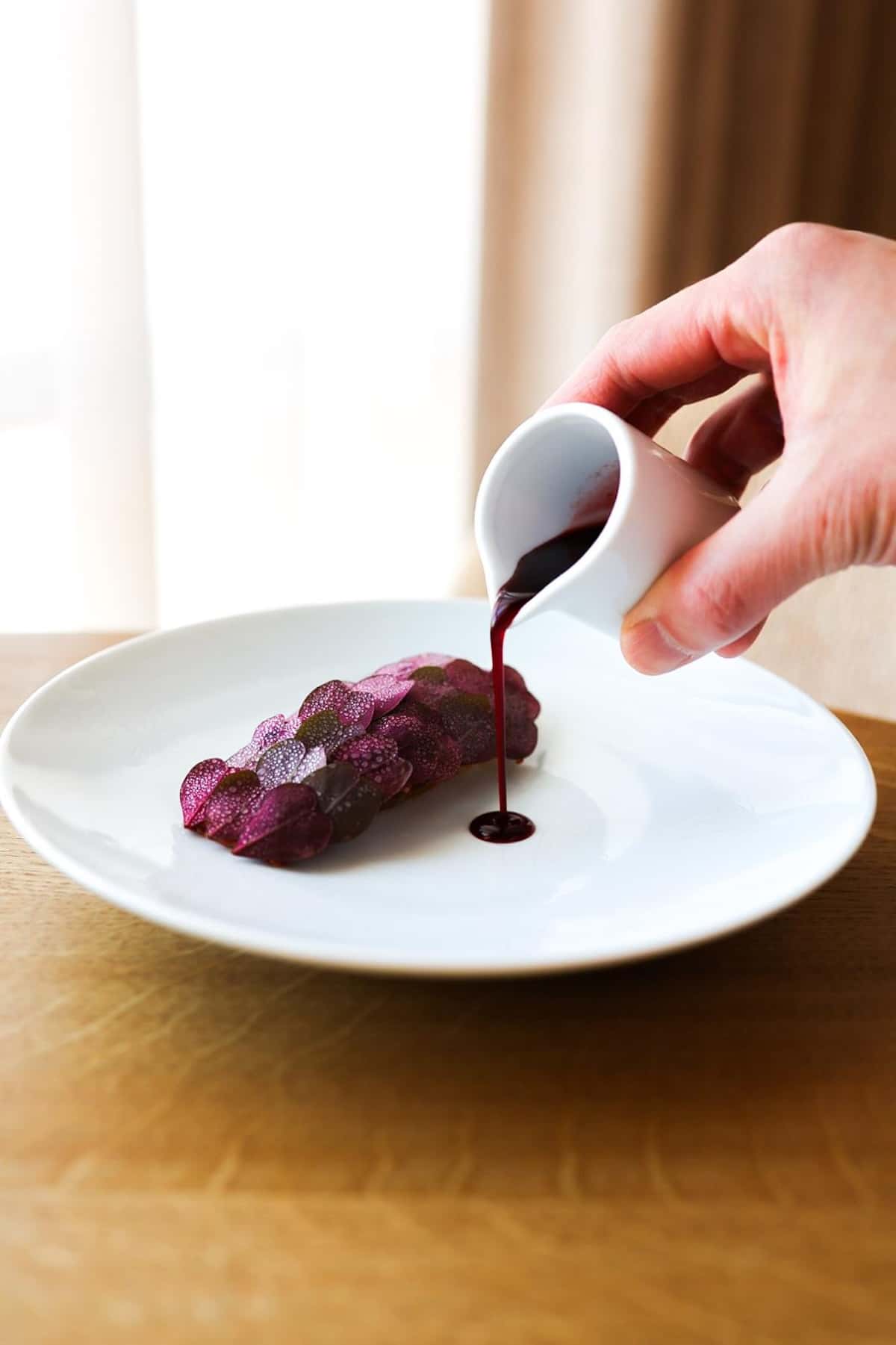
The current version: Norwegian langoustines, XL-sized and delivered live. The tail is poached, shelled, then grilled. On top is a paste of fermented blackened apples and batak berry — peppery like Sichuan. A thin slice of aged beef ribeye from the northwest of Denmark, cured in kimchi paste. Then layered oxalis leaves create a scale-like texture on top and provide acidity. While a sauce of beef emulsified with lobster butter, seasoned with beetroot reduction spreads around it. “It works because it’s very comforting. And there’s nothing wrong with that moment,” Kristian smiles at the indulgence.
“When I go out to tasting menu experiences, I would like a glass of red wine and some beef. And I think it’s quite important to provide that experience for our guests.”
The Right Timing
The drinks pairing was never going to be only wine, because, “we wanted to do something different.” When Koan opened its permanent doors in April 2023, Kristian already knew what that meant – working with likeminded people.
Peole like Emilie Yung who’s Danish-Korean. She’s spent years developing Korean sool (traditional Korean rice wines and makgeolli) in Copenhagen. When Kristian and Koan, and her Yunguna Brewery, based in Nordhavn, Copenhagen, sat down for a tasting, the decision was immediate. “We were just absolutely blown away,” Kristian shakes his head in awe. The timing was perfect — she was ready to launch at the same moment Koan was ready to open. The pairing now features Korean alcohol produced in Copenhagen, alongside imported distilled soju from Korea itself.
Then there is Muri, a Copenhagen non-alcoholic beverage producer. Koan were their first customers — back at the pop-up, before Muri became, as Kristian puts it with some restraint, “quite big.” For the tea dessert — a rice-based soufflé seasoned with milk, yuba and tea, served alongside ice cream of seaweed and hazelnut oil, finished with caviar — Muri developed a rice-based non-alcoholic drink made specifically for the pairing. “It was very unique. And it was a great match.”
Reborn At Koan Copenhagen
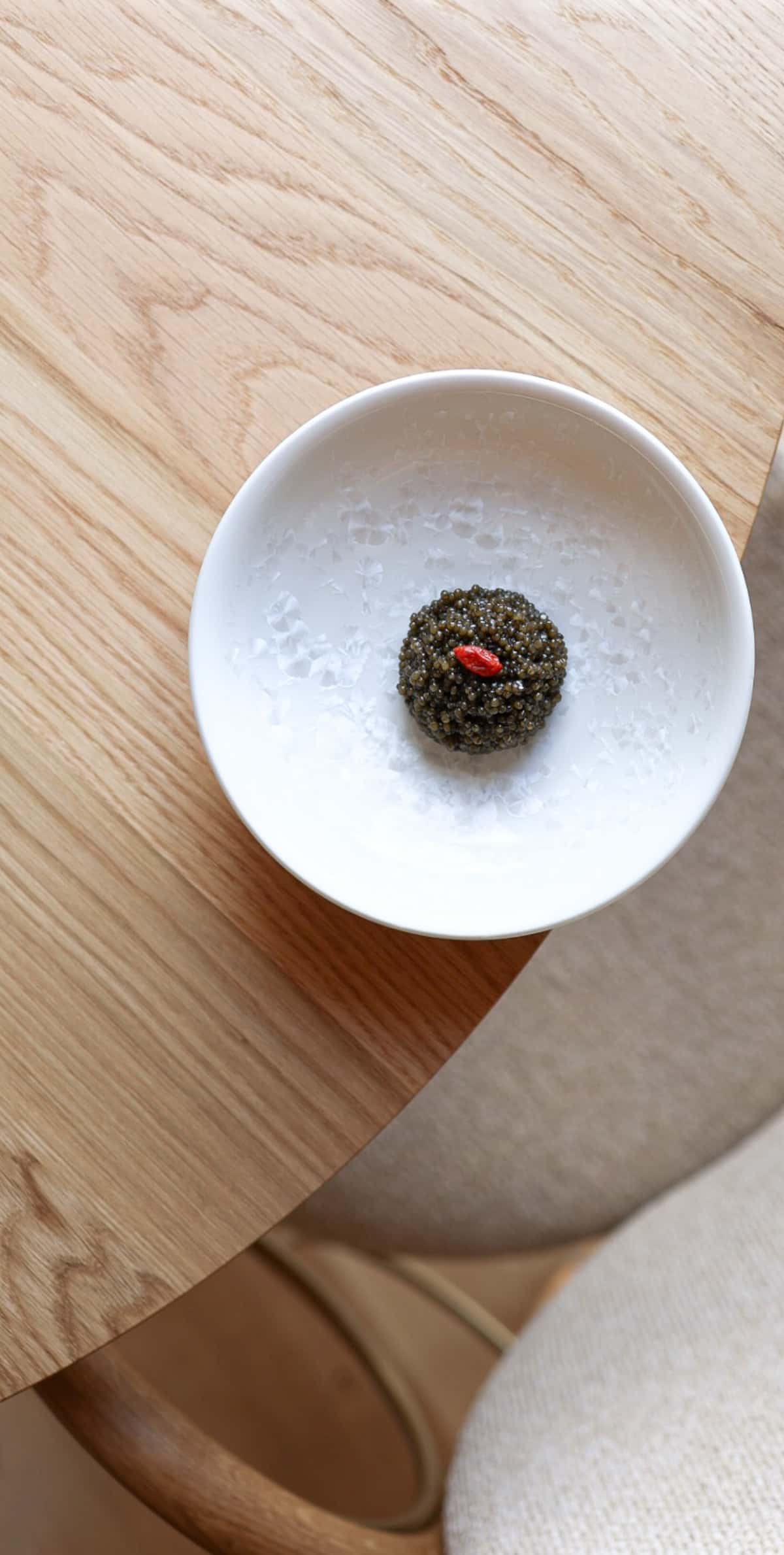
The vessels matter as much as what’s in them. When Kristian saw the plate for the caviar dish, he knew immediately. “This is the plate we’ve been looking for. I already knew what the dish would look like in my head.”
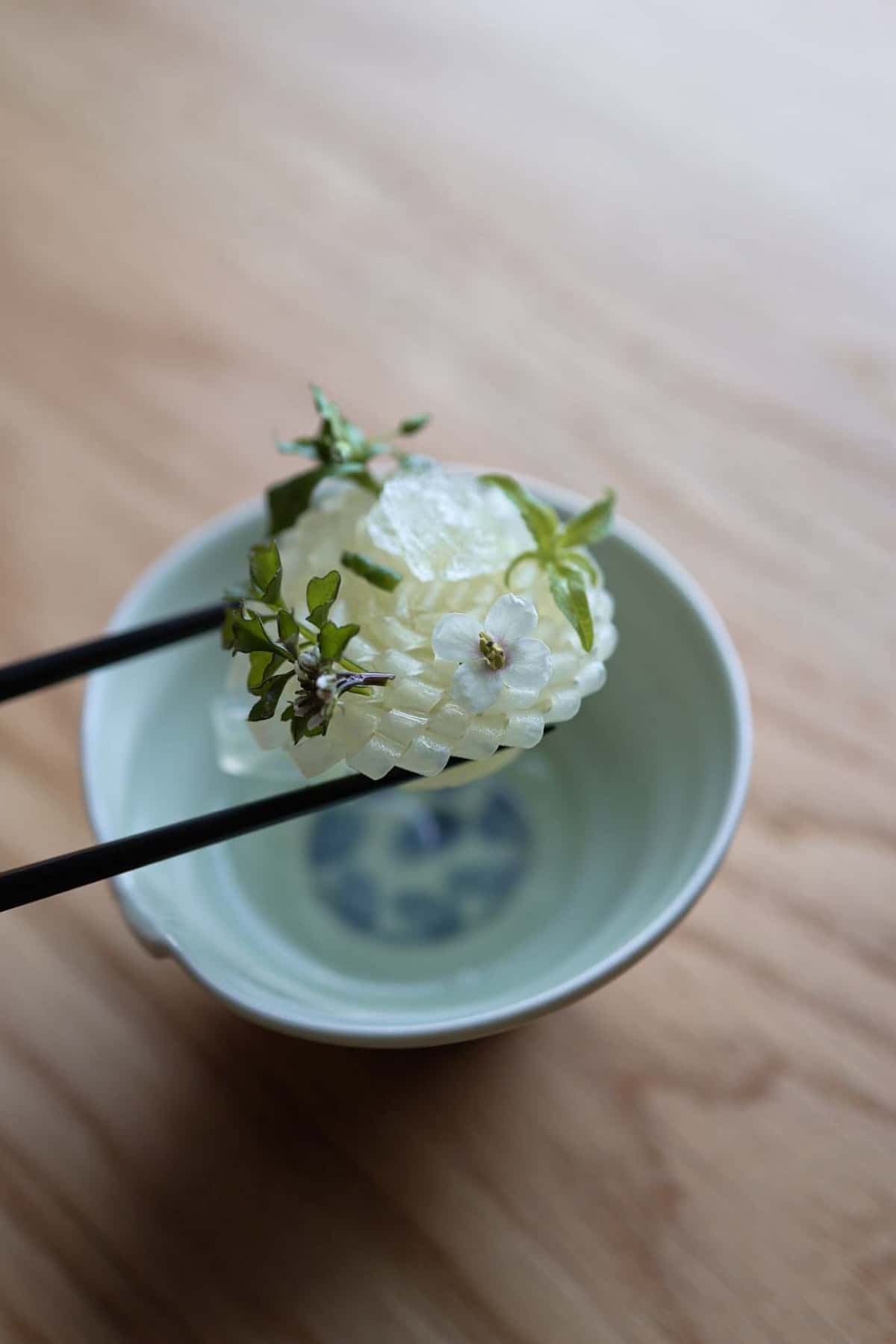
The bowl for the white kimchi flower came from a gallery — artist Lee Ki-jo salvaged ceramic fragments from as far back at the 14th century, sorted through the pieces that could be given new life, brought them back to Korea, turned them into new ceramics — embedding the broken pieces into new bowls — and made an exhibition. It was called Reborn.
“That was a perfect confirmation,” Kristian says — because Reborn is also Koan’s story. His former restaurant closed. He launched this one in the middle of COVID, on the other side of the water from where it now stands. The journey back to South Korea, to memory, to the food culture he has spent since 2011 trying to understand and honour. “It felt like the sun and the moon and the stars aligned.”
A Very Difficult Conclusion
And suddenly, those cobalt blue and mint green-patterned broken fragments that appear beneath the white kimchi are a reminder that despite all the obsessively fine-tuned details, or dishes like the caviar ball that looks like a perfect sphere, as in the incomplete ensō circle, perhaps Kristian and Koan aren’t striving for perfection at all. “I don’t strive for perfection,” he agrees. “I think perfection is a very difficult conclusion.”
It’s there in the name too, unresolvable, like a mystery. A koan is a question in Zen Buddhism with no correct answer — designed not to resolve but to open. “I want them to be more open,” Kristian says of his guests. Two people at the same table will finish with different favourite dishes. “I think it is actually okay.”
If someone leaves wanting to go to Korea, he says, that’s larger than anything the restaurant achieves on its own. “It brings me true joy. It’s much bigger than the restaurant.”
The brushstroke doesn’t close. You came hungry for dinner. You leave hungry for Korea, or hungry to come back — to see what the mandu has become by then, whether the langoustine is still on the menu, what Kristian has been working on since.